 Kono Vidovic
Luxury hotels approach background music by deciding, zone by zone, whether there should be any. That is the difference. An upper-upscale property asks what to play in each space; a genuinely luxury property asks first whether the space is better silent, and plays nothing in a meaningful number of them.
The palette question is settled and I have written it up elsewhere: restraint, few recognisable vocals, nothing trending, volume low enough for two people to speak at normal pitch. That applies to luxury brands generally and the hotel zone recommendations sit in my hotel music strategy guide. This page is about the three things those do not cover, all of which separate properties that get this right from properties that merely spend money on it.
Where Should a Luxury Hotel Play Nothing?
In the arrival sequence and in any space whose job is deference. This is the decision upper-upscale properties almost never make, and it is the clearest marker of the category.
Zones where I would argue for no music at all, or for something close to it:
- The threshold and reception desk. A guest arriving has just travelled. Silence at the desk reads as attention; music reads as a venue. The lobby beyond it can carry sound.
- Any space where a conversation is the product. A concierge desk, a private check-in room, a residence lounge. If someone is being advised, the room should not compete.
- A fine-dining room at the top of the market. Not every one, but at a certain level the sound of the room, the service and the kitchen is the intended soundtrack, and adding music is a decision to cover it.
- Corridors on guest floors, at night. Continuity is worth having by day. After a certain hour it is noise outside somebody’s door.
The point is not that luxury means quiet. It is that silence has to be chosen, written down and defended, because the default pressure in every property is to fill every space. A room that is silent because nobody got round to wiring it is not the same decision, and it does not survive the next refurbishment.
What Do Luxury Guests Actually Notice?
The edges, not the taste. A guest at this level will rarely object to a genre choice and will immediately register a seam, because a seam says the experience is being delivered by a system rather than designed.
| What guests notice | Why it reads as cheap | The fix |
|---|---|---|
| An audible track change | Reveals a playlist rather than a programme | Sequenced material with worked transitions |
| Any advertisement or voice tag | Consumer service on commercial premises | Never a consumer account. See the licence note below |
| Compression artefacts and thin high end | Good speakers fed a poor stream | Source quality, then check the signal chain |
| A visible speaker in a sightline | The infrastructure showing through | An AV conversation, not a music one |
| Volume that changes when staff change | Nobody owns it | A written number per zone |
| A chart track from eighteen months ago | Dates the room precisely | Nothing current, which is the standard advice |
That last row is the only one the general advice already covers. The other five are what separate a property that sounds designed from one that sounds subscribed, and none of them is about which tracks you chose.
What Separates Luxury from Upper-Upscale?
Not budget. Both can spend the same money, and I have heard upper-upscale properties with better sound than luxury ones. Three things actually differ.
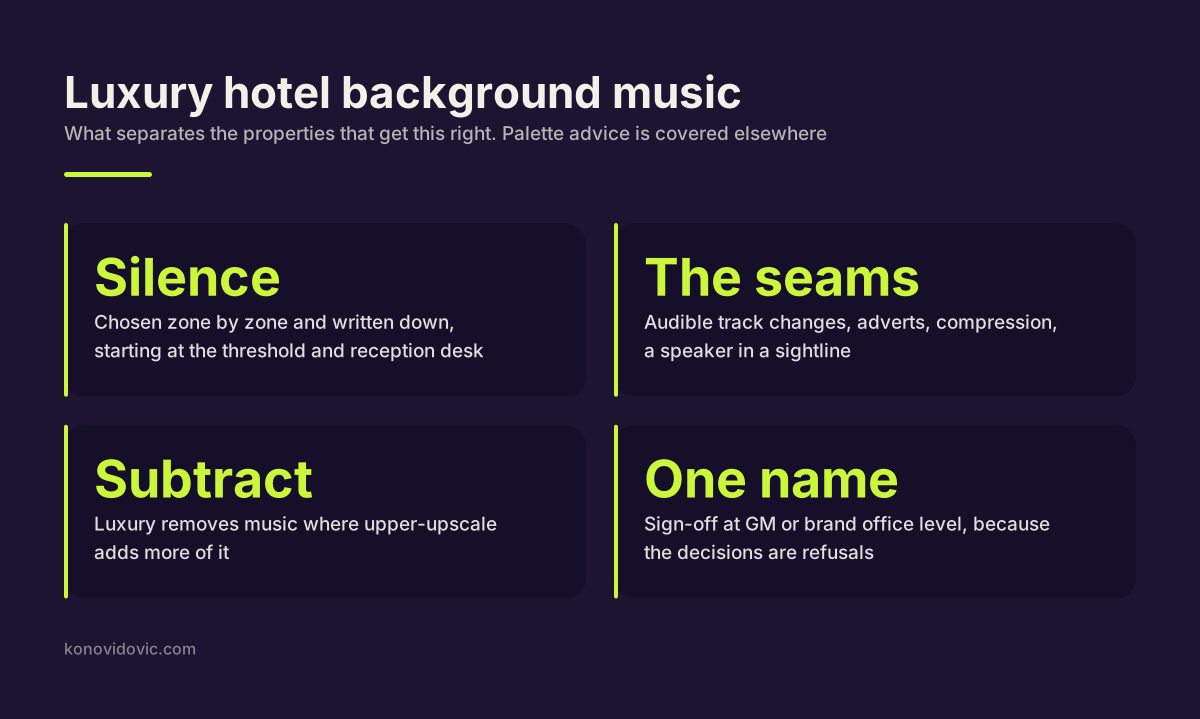
- Willingness to subtract. Upper-upscale adds: more zones, more hours, more of a good thing. Luxury removes, and the removal is the work. Anyone can fill a building with music.
- Tolerance for the unfamiliar. A luxury guest will accept music they do not recognise; an upper-upscale brief usually contains a quiet requirement that guests feel comfortable, which drifts toward the familiar, which drifts toward the recognisable, which drifts toward chart adjacency.
- Who is allowed to change it. At the top of the market the answer is almost nobody, and that is enforced. One step down, the duty manager can change it and does.
What I see at properties that get it right
- A written list of zones that are deliberately silent
- Sequenced material rather than a playlist on shuffle
- One named approver, and it is not the duty manager
- A volume number per zone, in writing, per daypart
- Someone walks the arrival sequence monthly and listens
What I see when money has been spent without a decision
- Music in every space because every space has a speaker
- A premium subscription on shuffle, never briefed
- Four people with the app on their phones
- Volume set by whoever was last complained at
- Nobody has listened to the lobby in a year
Who Signs It Off?
One named person, and at a luxury property it should sit with the general manager or the brand office rather than with operations. The reason is that the decisions that matter here are refusals, and a refusal needs authority behind it.
The specific refusals somebody has to be able to make: no, that zone stays silent; no, the restaurant does not get louder because it felt flat on Tuesday; no, we are not putting on something festive in week three of November; no, the duty manager does not get the password. Each of those is easy to write into a document and hard to hold without a name attached.
What should be in writing, and what belongs in a sonic brand guidelines document rather than in somebody’s head, I have set out in sonic brand guidelines. The hospitality-specific version, including why staff decide whether any of it survives, is in sonic branding in hospitality.
Does the Research Support Any of This?
Partly, and only in one direction. The congruence literature supports the idea that genre sets an expectation about price and quality: Areni and Kim’s 1993 field study in a wine store, published in Advances in Consumer Research, found shoppers selected more expensive merchandise when classical music played rather than Top-Forty.
That supports choosing a palette that agrees with your price point. It does not support any specific claim about silence, and I am not going to invent one. The case for silence in the arrival sequence is my own practice and the practice of the properties I rate, not a research finding, and it should be read that way.
The Licence, and Why It Matters More Here
The obligation is the same as at any other hotel, and the reputational exposure is higher. Public performance licensing is a per-premises obligation and the fee is calculated from the site’s own characteristics: PPL PRS, which issues TheMusicLicence in the UK, states the cost depends on venue type and use, with measures such as “square meterage, number of employees, or venue capacity”.
| Country | Societies | Licence route |
|---|---|---|
| Netherlands | Buma/Stemra and Sena | mijnlicentie.nl |
| UK | PPL and PRS for Music | TheMusicLicence via PPL PRS |
| Germany | GEMA and GVL | Separate, both required |
The specific risk at this level is a consumer streaming account running in a public area, which is not licensed for commercial use and which will eventually play an advertisement to your guests. Commissioning a mix or an identity never supplies a licence either. If the property spans several countries as part of a group, the mechanics are in music licensing across multiple locations.
Key Takeaways:
- The defining decision is whether a zone should have music at all. Luxury properties choose silence in specific spaces, deliberately and in writing, starting with the threshold and the reception desk.
- Guests at this level notice seams rather than taste: audible track changes, advertisements, compression, a speaker in a sightline, volume that moves when staff change.
- What separates luxury from upper-upscale is willingness to subtract, tolerance for unfamiliar music, and how few people are allowed to change anything.
- Sign-off belongs with the general manager or brand office, because the decisions that matter are refusals and a refusal needs authority.
- The research supports matching palette to price point, through the congruence findings. It does not support the case for silence, which is practice rather than evidence.
Frequently Asked Questions
How do luxury hotels approach background music?
By deciding zone by zone whether there should be music at all, and playing nothing in a meaningful number of spaces. Where music does play, the approach is restraint: sequenced rather than shuffled, few recognisable vocals, nothing current, and a volume that lets two people speak at normal pitch. The palette advice is similar across the luxury sector; the decision to subtract is what distinguishes the properties that get it right.
Should a luxury hotel lobby have music at all?
The lobby usually yes, the threshold and reception desk often no. A guest arriving has just travelled and silence at the desk reads as attention, while music reads as a venue. That is a decision to make deliberately and write down, because the default pressure in every property is to fill every space with sound.
What do luxury hotel guests notice about the music?
The seams rather than the selection. An audible track change, an advertisement from a consumer streaming account, compression artefacts on good speakers, a visible speaker in a sightline, or a volume level that shifts when the shift does. Guests at this level rarely object to a genre and immediately register anything that reveals the experience is being delivered by a system rather than designed.
What is the difference between luxury and upper-upscale hotel music?
Not budget. The differences are a willingness to remove music rather than add it, a tolerance for music guests will not recognise, and how few people are permitted to change anything. Upper-upscale briefs often contain a requirement that guests feel comfortable, which drifts toward the familiar and then toward chart adjacency.
Can a luxury hotel use a Spotify or Apple Music subscription?
No. A consumer subscription is licensed for personal, non-commercial listening, so playing it in a public area of a hotel is outside its terms regardless of the property’s standard, and it will eventually play an advertisement to guests. Use a commercial background music service or commissioned material, and arrange the public performance licence separately, because the music source never supplies it.
Who should decide the music in a luxury hotel?
One named person, at the level of the general manager or the brand office rather than operations. The decisions that matter at this level are refusals: that a zone stays silent, that the restaurant does not get louder because it felt flat, that the duty manager does not get the password. A refusal needs a name and authority behind it or it does not hold.
Want the silent zones, the volume numbers and the approval chain decided for your property rather than described? Get in touch with the zone list, or read hotel music consultancy for what the engagement covers.