 Kono Vidovic
Sonic branding in hospitality is the same discipline as anywhere else with one variable changed: duration. A retail shopper hears your brand for eleven minutes and an airline passenger hears a four-second signature. A hotel guest hears it for thirty-six hours, and your own staff hear it for eight hours a shift, five days a week. Almost everything that goes wrong in hospitality sound comes from that single difference.
I have built soundtracks and sonic identities for properties from boutique design hotels to large business hotels, and the briefs that fail are the ones written as though a guest encounters the brand once. If you want the identity defined and documented for your property rather than described in the abstract, that is what music strategy consulting covers. What follows is what changes when the brand has to last.
What Makes Sonic Branding in Hospitality Different?
Duration, and three consequences that follow from it.
- Catalogue depth stops being optional. A brand identity that works on a two-hour rotation is finished by lunchtime on day one. A guest staying two nights will pass through the lobby six or seven times, and if they hear the same track twice they stop hearing a brand and start hearing a loop.
- The same guest hears the arc more than once. Your evening lift is a designed effect the first time and a predictable one the second. A hospitality identity needs variation inside the arc, not just an arc.
- Repetition fatigue lands on staff first. They will hear the rotation hundreds of times before any guest hears it twice, and they are the ones with access to the volume knob.
That last point is not a footnote. It is the most common cause of failure I see, and it gets its own section.
Why Your Staff Decide Whether It Survives
Because they can change it, and if the music makes their shift worse they eventually will. No brand guideline survives a team that quietly hates the soundtrack.
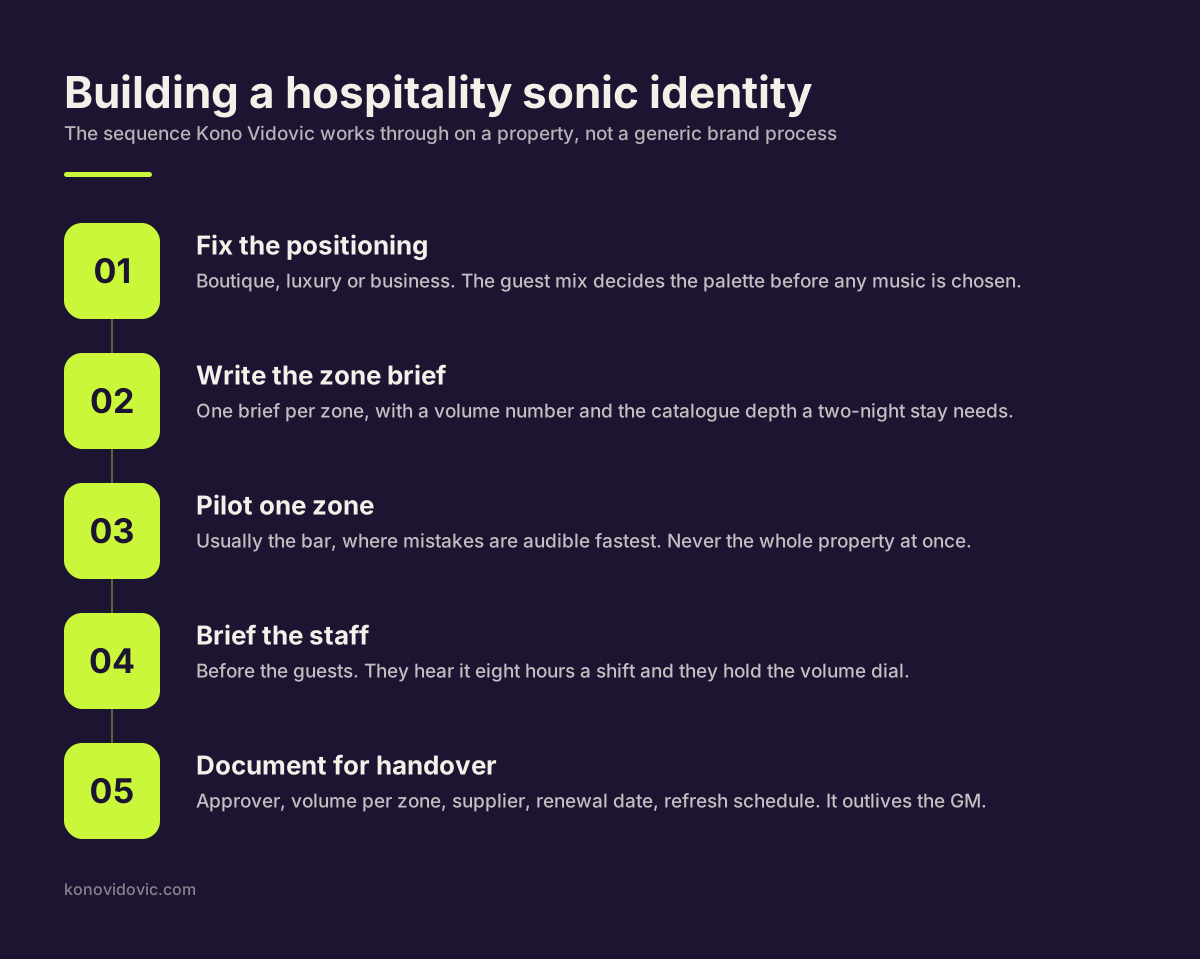
What I have learned to do differently in hospitality from any other sector:
- Brief the team before the guests. Ten minutes explaining what the music is doing and why converts the people most likely to undermine it into the people who protect it.
- Ask them what grates. They will name three tracks that sound fine once and unbearable on the fortieth hearing. They are right, and nobody else in the process can know this.
- Write the volume down as a number per zone, so holding it is following an instruction rather than overruling a colleague.
- Give one person per shift the authority to flag a problem, rather than leaving everybody free to solve it with the volume dial.
How Do You Hold the Brand Across Operators You Do Not Employ?
Through the contract, because instruction does not reach them. In a lot of properties the restaurant is leased, the spa is run by a wellness operator and the gym is a third-party brand. Each of those is a company with its own identity, and none of them reports to your marketing team.
This is distinct from running one brand across several of your own sites, which turns on central and local governance and which I have set out in multi-location music strategy. Inside a single property the problem is different: the zones belong to different businesses.
| Zone status | What you can realistically require | Where it breaks |
|---|---|---|
| Operated by you | Palette, volume ceiling, source and refresh schedule | Staff substitution at shift level |
| Leased with a brand of its own | Agreed palette boundaries at the lease, little else | Their brand standard conflicts with yours |
| Third-party managed, white label | Usually the full brief, because they have no identity to defend | Nobody is named as responsible |
| Franchised | A recommendation plus a commercial argument | Open opt-out at renewal |
The practical move is to settle the sound in the lease or management agreement rather than afterwards. A clause agreed before anyone moves in costs nothing; the same conversation two years later is a renegotiation.
What Does the Research Actually Support?
Direction, not percentages. The literature supports two claims that matter in hospitality and does not support the specific figures that circulate alongside them.
Milliman’s 1986 study in the Journal of Consumer Research found that slower background music kept restaurant patrons in their seats longer, and that the pace of the room followed the pace of the music. North, Hargreaves and McKendrick, writing in the Journal of Applied Psychology in 1999, changed which country’s wine sold by playing French or German music on alternate days, and the shoppers questioned afterwards had no idea the music had affected them.
That second finding is the one hospitality operators should take seriously, and it cuts both ways: guest feedback is the wrong instrument for judging a soundtrack. People cannot report an effect they did not notice. If you are testing whether the music works, look at dwell time and spend per head, not at comment cards.
The BPM bands I programme per zone are industry convention and my own practice rather than research findings, and I have published them in the right BPM for restaurant and retail music.
Continuity Is the Hospitality Problem, Not Zone Design
Designing each zone is the easy half and it is already solved. What almost nobody gets right is the thirty seconds between zones.
Which music belongs in a lobby, a bar, a restaurant, a spa and a gym is set out zone by zone in my guide to hotel music strategy, so this page does not repeat it. The point here is that a guest does not experience five zones. They experience one walk: in from the street, past reception, through the bar, into the restaurant, and back past the spa to the lift. The brand is the continuity, not the five separate rooms.
Three things hold it together:
- A shared family of artists and production styles across zones, applied at different energies, so the rooms are variations rather than unrelated choices.
- Transitions that do not jump. A fifteen to twenty BPM step between adjacent spaces reads as walking into a different building.
- Corridors and lifts treated as part of the identity rather than as leftover space. They are the only zones whose entire job is continuity.
What Survives a Change of General Manager?
Only what is written down. General managers move every two or three years, and a sonic identity held in one person’s head leaves with them.
The document that carries it is a sonic brand guidelines document, and what belongs inside one is a subject of its own which I have covered in sonic brand guidelines. In hospitality the clauses that matter most are the ones nobody thinks to include: who approves a change, what the volume number is per zone, who the music supplier is and when the contract renews, and what the refresh schedule is. A successor inherits the reasoning rather than a playlist.
What Does It Cost?
| Deliverable | Price | Unit |
|---|---|---|
| Custom mix, 60 minutes | EUR 249 | Per mix, one-off, excludes VAT where applicable |
| Custom mix, 90 minutes | EUR 349 | Per mix, one-off, excludes VAT where applicable |
| Custom mix, 120 minutes | EUR 449 | Per mix, one-off, excludes VAT where applicable |
| Sonic identity and strategy | Request a quote | Per property, scoped on zones and number of sites |
| Public performance licence | Set by your collecting society | Per premises, recurring, never included above |
Catalogue depth is where a hospitality budget actually goes. A property needing four zones with enough material to avoid repetition over a two-night stay is a different commission from a single mix, and pricing it as one mix per zone underestimates it.
Music Licensing Is Separate from Your Sonic Identity
Your sonic identity is what you sound like. Your licence is permission to play recorded music in public, and no amount of brand work supplies it.
Public performance licensing is a per-premises obligation and the fee is set by each site’s own characteristics. PPL PRS, which issues TheMusicLicence in the UK, states that the cost depends on the type of venue and how music is used, and that fees are calculated using measures such as “square meterage, number of employees, or venue capacity”.
| Country | Societies | Licence route |
|---|---|---|
| Netherlands | Buma/Stemra and Sena | mijnlicentie.nl |
| UK | PPL and PRS for Music | TheMusicLicence via PPL PRS |
| Germany | GEMA and GVL | Separate, both required |
| United States | ASCAP, BMI, SESAC and GMR | Separate licences, no joint venture |
Commissioning an identity never supplies a licence, and neither does buying a prepared mix. Where a leased restaurant or third-party spa operates inside your property, confirm in writing which legal entity each licence names, because that is the detail that unravels at an inspection.
Key Takeaways:
- Hospitality sonic branding differs from every other sector on one variable: a guest hears it for thirty-six hours and staff hear it for eight hours a shift, so catalogue depth and variation inside the arc stop being optional.
- Your staff decide whether the identity survives, because they have the volume dial. Brief them before the guests and ask them which tracks grate on the fortieth hearing.
- Leased restaurants, third-party spas and franchised gyms cannot be instructed, only contracted. Settle the sound in the lease, not two years later.
- Zone design is already solved; continuity between zones is the actual hospitality problem, and corridors and lifts exist to carry it.
- Only what is written down survives a change of general manager, and the licence is per premises whatever the identity work says.
Frequently Asked Questions
What is sonic branding in hospitality?
The deliberate design of what a property sounds like across every zone a guest passes through, documented so it survives staff and management changes. It differs from sonic branding in other sectors mainly in duration: a guest is exposed to it for a whole stay rather than a single visit, and staff hear it every shift, which makes catalogue depth and variation inside the arc more important than the opening choice of genre.
How is it different from just having good playlists in each zone?
A playlist per zone is five separate decisions. A sonic identity is one decision applied five ways, with a shared family of artists and production styles so the rooms read as the same brand at different energies. The test is whether a guest walking from the lobby to the restaurant hears a transition or hears a different building.
How do I control the music in a leased restaurant inside my hotel?
Through the lease or management agreement, because a leased operator does not take instruction from your marketing team. Agree palette boundaries and a volume ceiling at the point the agreement is signed. If the space is already let, the conversation is a renegotiation and usually waits for renewal, which is why this clause is worth adding to every future agreement now.
Does guest feedback tell me whether the music is working?
No, and that is the most useful finding in the research. North, Hargreaves and McKendrick showed in 1999 that people cannot report the effect music had on their choices, so comment cards measure whether guests noticed the music rather than whether it worked. Use dwell time and spend per head instead.
How often should a hospitality sonic identity be refreshed?
Put a schedule in the guidelines document rather than refreshing when somebody complains, and treat the staff as your early warning: they hit repetition fatigue months before guests do. The refresh that matters is usually adding depth to the existing palette rather than changing direction, because changing direction resets the brand recognition you have been building.
Do I still need a music licence if I commission a sonic identity?
Yes. A sonic identity is what your property sounds like; a public performance licence is permission to play recorded music in public, and the two are separate purchases. It is a per-premises obligation priced on each site’s own characteristics. In the Netherlands that means Buma/Stemra and Sena through mijnlicentie.nl, in the UK TheMusicLicence from PPL PRS, in Germany GEMA and GVL.
Want the identity defined for your property, zone by zone and written down so it outlives the current team? Get in touch with the zones and the number of sites, or read music strategy consulting for what the engagement covers.


