 Kono Vidovic
Sonic branding for luxury brands is the deliberate design of every sound the brand makes, from the boutique playlist to the tone a card reader plays at checkout, so that sound carries the same meaning as the logo and the packaging. In luxury the governing discipline is restraint: fewer sounds, better sources, and far more silence than a mass-market brand would tolerate.
I have spent 34 years behind the decks and the last stretch of that building soundtracks for hospitality and retail spaces. The luxury brief is the only one where I am regularly asked to take music away rather than add it, and that instinct is usually correct. What follows is the process I run when a brand asks for music strategy consulting instead of a playlist.
What Is Sonic Branding for Luxury Brands?
Sonic branding for luxury brands is a written system that decides what the brand sounds like at every touchpoint, not a track and not a playlist. It covers the music in the space, the sound marks in film and digital products, the noises the physical product makes, and the moments where the correct answer is nothing at all.
The distinction that matters is between having music and having a sonic identity:
- Playing music is a weekly decision made by whoever has the login. It drifts with the seasons and the staff.
- A sonic identity is a documented set of rules: approved sources, genre palette, tempo range, volume by daypart, and who signs off on a change.
- Sound design is the layer most brands forget: the closure on a jewellery box, the damped click of a hinge, the alert tone in the app.
I cover the general discipline in my complete guide to sonic branding. This piece is about what changes when the brand sells at the top of the market.
Why Is Luxury Sound Different from Mass-Market Sound?
Luxury sound is different because luxury sells scarcity, and scarcity has an acoustic signature. Mass-market retail uses music to lift energy and move people through the space. Luxury uses it to slow them down, hold them in a room, and make the room feel like it belongs to them alone.
Luxury approach
- Fewer tracks, chosen and sequenced by hand
- Long instrumental passages, few recognisable vocals
- Volume low enough that two people can speak at normal pitch
- Planned silence between sections, not accidental gaps
- Recordings sourced for audio quality, not just for mood
Default mass-market approach
- Algorithmic playlist refreshed without a brief
- Current chart vocals that date the room within months
- Volume set by whoever was last annoyed by it
- Wall-to-wall sound with no dynamic range
- Compressed streams on consumer hardware
The resolution is not that one is better in the abstract. A gym needs the second column. A watch salon that uses the second column is telling customers it is a shop.
What Does the Research Actually Support?
The research supports congruence, not a magic genre: music that fits the brand’s positioning shifts what people choose and what they are willing to pay, and no specific playlist has been shown to do this on its own.
Three papers are worth naming, because they are the ones that hold up:
- Areni and Kim (1993), Advances in Consumer Research. In a field experiment in a wine store, classical music rather than Top-Forty led shoppers to select more expensive merchandise. They did not buy more bottles. They bought dearer ones.
- North, Hargreaves and McKendrick (1999), Journal of Applied Psychology. French and German music played on alternate days beside a display of French and German wines shifted which country’s wine sold. Customers questioned afterwards were unaware the music had influenced them.
- Krishna (2012), Journal of Consumer Psychology. Her review of sensory marketing describes sensory cues acting as subconscious triggers that shape how people perceive abstract product qualities such as sophistication and quality.
Note what none of these say. None of them gives a percentage uplift you can bank, and any number you see quoted as one has usually been laundered through three blogs. I do not publish those and you should not budget against them.
How Do You Build a Luxury Sonic Identity?
You build it in five steps, ending in a document rather than a playlist. The document is the deliverable, because a playlist without rules decays the moment the person who made it moves on.
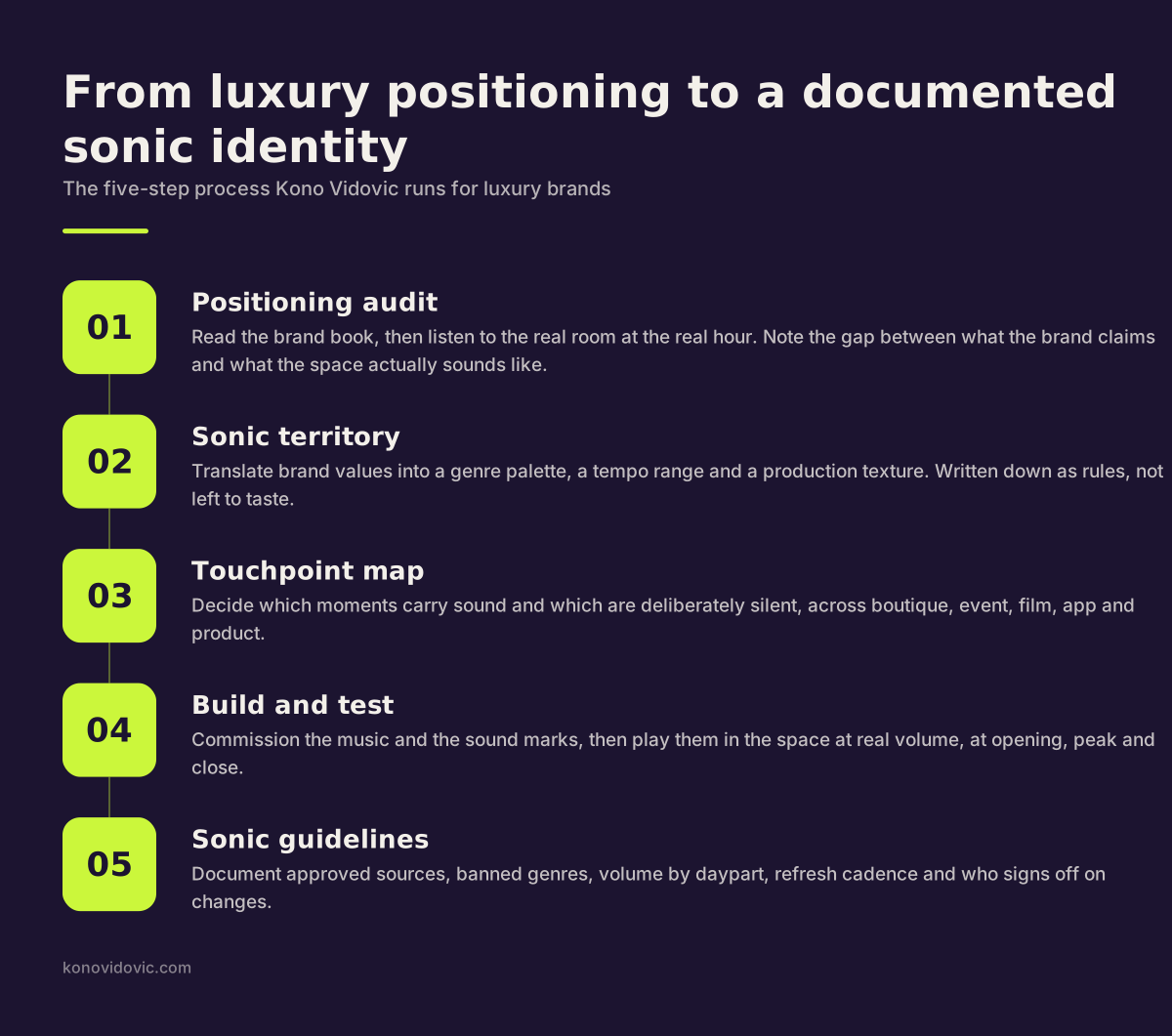
Step two is where most programmes are won or lost. “Elegant” and “timeless” are not a brief. A usable sonic territory reads like this: mid-century modal jazz, ambient and neoclassical piano, 60 to 90 BPM, acoustic and analogue textures, no chart vocals, no four-on-the-floor, no tracks released in the last 18 months. Those are rules a third party can follow without calling you.
Which Touchpoints Need Sound, and Which Need Silence?
Most luxury brands have four or five touchpoints that carry sound and at least two that should be silent. Mapping this before commissioning anything is what stops you paying for audio that gets switched off in week three.
| Touchpoint | What it needs | What kills it |
|---|---|---|
| Boutique or salon floor | Continuous curated music, low volume, wide dynamic range | Chart vocals, compressed streams, ad breaks |
| Private client room | Near silence or a very sparse ambient bed | Anything with a beat or a lyric |
| Brand film and campaign | A commissioned score built on the sonic territory | Library music that also scores a car advert |
| App and digital product | Two or three short sound marks, opt-in by default | A start-up jingle that fires on every launch |
| Product itself | Deliberate mechanical sound: closure, hinge, clasp | Leaving it to whatever the tooling produces |
| Checkout and payment | Silence, or a single discreet confirmation tone | Loud confirmation beeps from the terminal |
| Events and activations | A live DJ reading the room, working to the territory | A laptop on shuffle at the back of the room |
That product row is not theoretical. Premium automotive has been running it hard since European rules under Regulation (EU) No 540/2014 made an acoustic vehicle alerting system mandatory for new vehicle types from 1 July 2019 and for all new vehicles from 1 July 2021. Electric cars had to be given a sound, so brands designed one rather than accept a generic tone. BMW’s published work with composer Hans Zimmer on drive sounds for its electric models is the clearest example of a premium brand treating a compliance requirement as a branding opportunity.
What Does Sonic Branding for a Luxury Brand Cost?
There is no single price, because a sound mark for an app and a year-long boutique soundtrack are different products. These are my published rates for the part that is productised, in euros, as of 2026:
| Deliverable | Price | Unit | Qualifier |
|---|---|---|---|
| Custom DJ mix, 60 minutes | EUR 249 | Per mix | Excludes VAT where applicable |
| Custom DJ mix, 90 minutes | EUR 349 | Per mix | Excludes VAT where applicable |
| Custom DJ mix, 120 minutes | EUR 449 | Per mix | Excludes VAT where applicable |
| Sonic identity programme | Indicative, request a quote | Per project | Scope depends on touchpoint count |
| Live event DJ | Indicative, request a quote | Per event | Excludes travel and accommodation |
Delivery on a custom DJ mix from EUR 249 is 7 days from an approved brief. A full identity programme runs on a longer clock because steps one and four involve being physically in the space.
That is the summary. For the document in full, including who signs off on each part and what happens when a site deviates, see sonic brand guidelines.
Music Licensing Is Separate from Your Sonic Identity
A custom mix is a music source, not a licence. It replaces the streaming service as the place your music comes from, and it does nothing to your public performance obligations. Any commercial space playing recorded music still needs its own licence, and the requirement varies by country.
In the Netherlands that means a combined Buma/Stemra and Sena licence, arranged through mijnlicentie.nl. In the UK it is TheMusicLicence from PPL PRS. In Germany you need both GEMA and GVL. In the United States there is no joint venture, so ASCAP, BMI, SESAC and GMR are separate negotiations. Every competitor page I read while researching this one blurred that line. I am stating it plainly because a luxury brand with a compliance function will check, and finding out the hard way is not the moment you want.
Five Mistakes I See in Luxury Sonic Branding
- Buying a sound mark before a territory. The logo sting gets commissioned first because it is the fun part, then nothing else agrees with it.
- Confusing quiet with slow. Low volume is a luxury signal. Uniformly slow tempo across twelve hours just makes people tired.
- Letting the space run on a consumer streaming account. Beyond the licensing problem, the algorithm will eventually serve something that contradicts the brand, usually at the worst hour.
- Refreshing on a marketing calendar. Seasonal campaigns turn over every quarter. A sonic identity that turns over every quarter is not an identity.
- Never writing it down. If the rules live in one person’s head, the identity leaves when they do.
If you run hospitality as well as retail, the daypart logic in my notes on the best music for hotels transfers directly to a flagship store with a long trading day.
Key Takeaways:
- Sonic branding for luxury brands is a documented rule set covering music, sound marks, product sound and planned silence, not a playlist.
- The luxury discipline is restraint: fewer tracks, lower volume, wider dynamic range, and touchpoints that are deliberately silent.
- Research supports congruence between music and positioning, not any specific genre, and no credible percentage uplift figure exists.
- Step two, writing a sonic territory as rules a third party can follow, is where programmes succeed or fail.
- A custom mix is a music source and never a licence. The venue still needs its own public performance licence, which varies by country.
Frequently Asked Questions
What is sonic branding for luxury brands?
It is the deliberate design of every sound a luxury brand makes, across the retail space, brand film, digital products, the physical product and events, governed by a written document rather than by taste. The luxury version is defined by restraint and by treating silence as a designed element.
Is sonic branding different from just choosing good background music?
Yes. Background music is a recurring decision someone makes each week. A sonic identity is a fixed set of rules covering genre palette, tempo range, volume by daypart, approved sources and sign-off, so the brand sounds the same in Amsterdam and in Milan without anyone coordinating it.
Does classical music make a store feel more expensive?
Areni and Kim’s 1993 field study in a wine store found shoppers selected more expensive merchandise when classical music played rather than Top-Forty. That is evidence for congruence between the music and the product category, not proof that classical music works everywhere. A contemporary fashion brand playing chamber strings reads as a costume, not as luxury.
How long does it take to build a luxury sonic identity?
A productised custom mix is delivered in 7 days from an approved brief. A full identity programme takes longer because the positioning audit and the testing step both require being in the space at trading hours, often across more than one site.
Does a custom mix cover my music licensing?
No. A custom mix is a music source, not a licence. Any venue playing recorded music publicly still needs its own public performance licence: Buma/Stemra and Sena in the Netherlands, TheMusicLicence in the UK, GEMA and GVL in Germany, and separate ASCAP, BMI, SESAC and GMR licences in the United States.
Should a private client room have music at all?
Usually not. A private appointment is a conversation, and music that forces either party to raise their voice works directly against the sale. If the silence feels stark, a very sparse ambient bed at the edge of audibility is the most I would put in there.
How often should a luxury sonic identity be refreshed?
The rules should hold for years. The music inside them should be refreshed on a regular cadence, quarterly is a sensible default, so the room stays alive without the identity drifting. Changing the rules every season means you never had an identity to begin with.
Ready to give your brand a sound it can own? Book a free discovery call and we will start with what your space actually sounds like today.


