 Kono Vidovic

A group with sites in several countries needs a public performance licence in each country, from that country’s own collecting societies, and there is no single European licence that replaces them for music played in premises. The EU regime that does allow multi-territorial licensing is scoped to online use, not to a shop or a hotel playing music to the people inside it.
That one distinction is where most of the confusion sits, and it costs groups real time at renewal and at inspection. I work with multi-site operators on what they play rather than on their compliance, so treat this as the map a music consultant hands you before you call your own societies, not as legal advice. If you want the sound itself handled consistently across sites, that is music strategy consulting, and the governance side is in multi-location music strategy.
Is There a Single European Music Licence for a Group?
Not for music played in premises. The European framework for multi-territorial licensing is Directive 2014/26/EU, and Article 1 states that it “lays down requirements for multi-territorial licensing by collective management organisations of authors’ rights in musical works for online use”. Article 3(n) defines those online rights by reference to Articles 2 and 3 of Directive 2001/29/EC, which are the rights a streaming service needs.
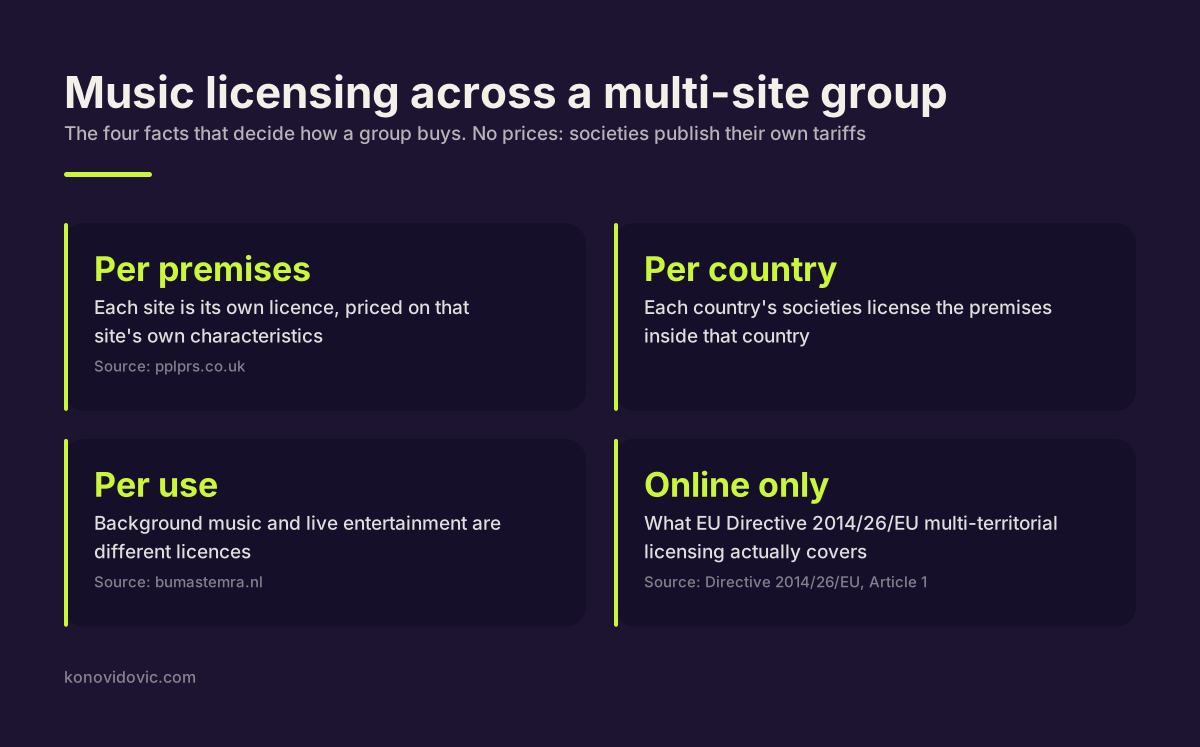
So the thing that lets Spotify operate across Europe on multi-territorial licences is not the thing that covers your twelve shops. Playing recorded music to customers in a physical space is licensed nationally, by the societies of the country the space is in.
That is the single most useful fact in this article, and it is the one most often got wrong in group procurement, where somebody reasonably assumes the single market means a single licence.
What a Group Actually Has to Handle
Three axes, and most operators only know about the first one.
- Per premises. Each site is its own licence. PPL PRS, which issues TheMusicLicence in the UK, states the cost depends on the type of venue and how music is used, and that fees are calculated using measures such as “square meterage, number of employees, or venue capacity”. Those are site-level measures, so a fifteen-site group is fifteen separate calculations rather than one multiplied by fifteen.
- Per country. Different societies, different registration routes, different renewal cycles and different tariff structures. A registration in one country does not reach a venue in another, which I have also noted in music licensing for restaurants.
- Per use. This is the axis groups forget. BumaStemra’s own guidance notes that a venue “may already have a licence for background music” but that “a performance constitutes entertainment music, so this needs a different licence”. A background licence across your estate does not automatically cover the live night, the DJ or the ticketed event.
| Country | Societies | Licence route |
|---|---|---|
| Netherlands | Buma/Stemra and Sena | mijnlicentie.nl |
| UK | PPL and PRS for Music | TheMusicLicence via PPL PRS |
| Germany | GEMA and GVL | Separate, both required |
| Canada | SOCAN and Re:Sound | Entandem |
| Australia | APRA AMCOS and PPCA | OneMusic Australia |
| United States | ASCAP, BMI, SESAC and GMR | Separate licences, no joint venture |
I deliberately publish no licence figures. Every price I have found in research traced back to a reseller rather than to a society, and the societies set their own tariffs and publish them. Get the number from the society.
Who Should the Licence Name?
The legal entity that operates the site, which in a group is often not the entity that signed the music contract. This is the detail that unravels at an inspection and it is worth settling before one happens.
Where the restaurant inside your hotel is leased or the gym is run by a third party, the operator of that space is usually the one who needs the licence for it. A central team can coordinate that, but it cannot hold a licence on behalf of a business it does not operate and assume the obligation is discharged.
Does a Global Music Service Cover It?
It covers your music source and, depending on the provider, some rights that come with that source. It does not replace the public performance licence you owe in each country.
This is the most expensive misunderstanding in multi-site music, because the provider’s pitch and the operator’s question are not quite the same question. A commercial background music service supplies legally cleared material and may bundle certain rights into its subscription, and that is genuinely different from a consumer streaming account, which is not licensed for commercial use at all. What it does not do is discharge the national public performance obligation for each of your premises.
The four routes and what each one settles are compared in retail store music and commercial background music. A prepared mix is the same case: it is where the music comes from, not permission to play it in public.
| What you are buying | What it settles | What it leaves |
|---|---|---|
| Consumer streaming subscription | Personal listening only | Everything. Not licensed for commercial use |
| Commercial background music service | A cleared source, plus rights the provider states | The public performance licence per premises, per country |
| Custom mix, owned outright | A cleared source you control | The public performance licence per premises, per country |
| Public performance licence | Permission to play music in that space | Where the music comes from |
What to Ask a Provider That Claims to Handle It
Ask which specific obligation they discharge, in which countries, and get the answer in writing. “We handle licensing” is not an answer, because it can mean anything from clearing the recordings to actually registering your premises.
- Which licence, named. Not “licensing” but the specific obligation: the recording rights, the composition rights, or the national public performance registration for each site.
- In which countries, by name. A provider may handle one market well and have no presence in another where you operate.
- Whose name is on it. Yours or theirs, and for which entity.
- What happens at an inspection. Who produces the paperwork and how fast.
- What is not included. The most useful question, and the one a good provider answers without hesitating.
A provider who narrows the claim when pressed is being honest about a genuinely complicated area. One who keeps the claim broad is the one to worry about.
Key Takeaways:
- There is no single European licence for music played in premises. Directive 2014/26/EU scopes multi-territorial licensing to authors’ rights in musical works for online use, so physical premises are licensed nationally.
- A group handles three axes, not one: per premises, per country, and per use. Background music and live entertainment are different licences.
- Each site’s fee is calculated on that site’s own characteristics, so a fifteen-site group is fifteen calculations rather than one multiplied out.
- The licence should name the entity that operates the site, which in a group is often not the entity that signed the music contract. Settle that before an inspection, especially for leased and franchised units.
- A music service supplies a source and may bundle some rights. It does not discharge the national public performance obligation for your premises, and neither does a prepared mix.
Frequently Asked Questions
Is there a single music licence that covers a business in several European countries?
Not for music played in premises. Directive 2014/26/EU, which created the European framework for multi-territorial licensing, states in Article 1 that it covers multi-territorial licensing of authors’ rights in musical works for online use. Public performance in a physical space is licensed by the societies of the country the space is in, so a group with sites in three countries deals with three sets of societies.
Does one licence cover all of my locations in the same country?
Ask your own society, because the answer depends on the scheme and sometimes on your structure. What is consistent is that the fee is calculated from each site’s characteristics rather than charged once for the business: PPL PRS states that fees use measures such as square meterage, number of employees or venue capacity. Treat it as a per-site calculation and let the society tell you how it is invoiced.
Our music provider says licensing is handled. Is it?
Partly, and the word is doing a lot of work. A commercial background music service supplies cleared material and may bundle certain rights, which is genuinely different from a consumer streaming account that is not licensed for commercial use at all. It does not normally discharge the national public performance obligation for each of your premises. Ask which specific licence they hold, in which countries, and in whose name.
Who holds the licence for a leased restaurant inside our hotel?
Normally the business that operates that space, which is the tenant rather than the hotel. A central team can coordinate it, but it cannot hold a licence on behalf of a business it does not operate and treat the obligation as discharged. Settle it in the lease rather than afterwards, and record which entity is named per address.
Does a background music licence cover a live night or a DJ?
Often not. BumaStemra’s guidance notes that a venue may already hold a licence for background music but that a performance constitutes entertainment music and needs a different licence. If any of your sites run live music, club nights or ticketed events, check the use scope of each licence rather than assuming the background licence stretches.
What does multi-country music licensing cost?
I do not publish figures, because every price I have found in research traced back to a reseller rather than to a collecting society, and the societies set and publish their own tariffs. The fee depends on the country, the venue type, how music is used and site-level measures such as floor area, employees or capacity. Get the number from each society directly, through mijnlicentie.nl in the Netherlands, PPL PRS in the UK or GEMA and GVL in Germany.
Want the music itself consistent across every site while your own team handles the licences? Get in touch with the countries and the number of sites, or read music strategy consulting for what the engagement covers.


