 Kono Vidovic
A hotel delivers different music to different public areas by giving each area its own independently addressable audio output, fed either by a separate player per zone, by one multi-zone device, or by a commercial service that supports zones in software. Four zones means four independent streams, and the question is only which of those three routes you use to produce them.
I get asked what each zone should play far more often than how the music physically gets there, and the second question is the one that sinks projects. A strategy that assumes four streams and a building wired for one will not survive its first week. What to play in each room is set out zone by zone in my guide to hotel music strategy; this page is about the delivery, which that guide does not cover.
What Counts as a Zone?
An independently addressable output, not a room. That distinction decides what you have to buy.
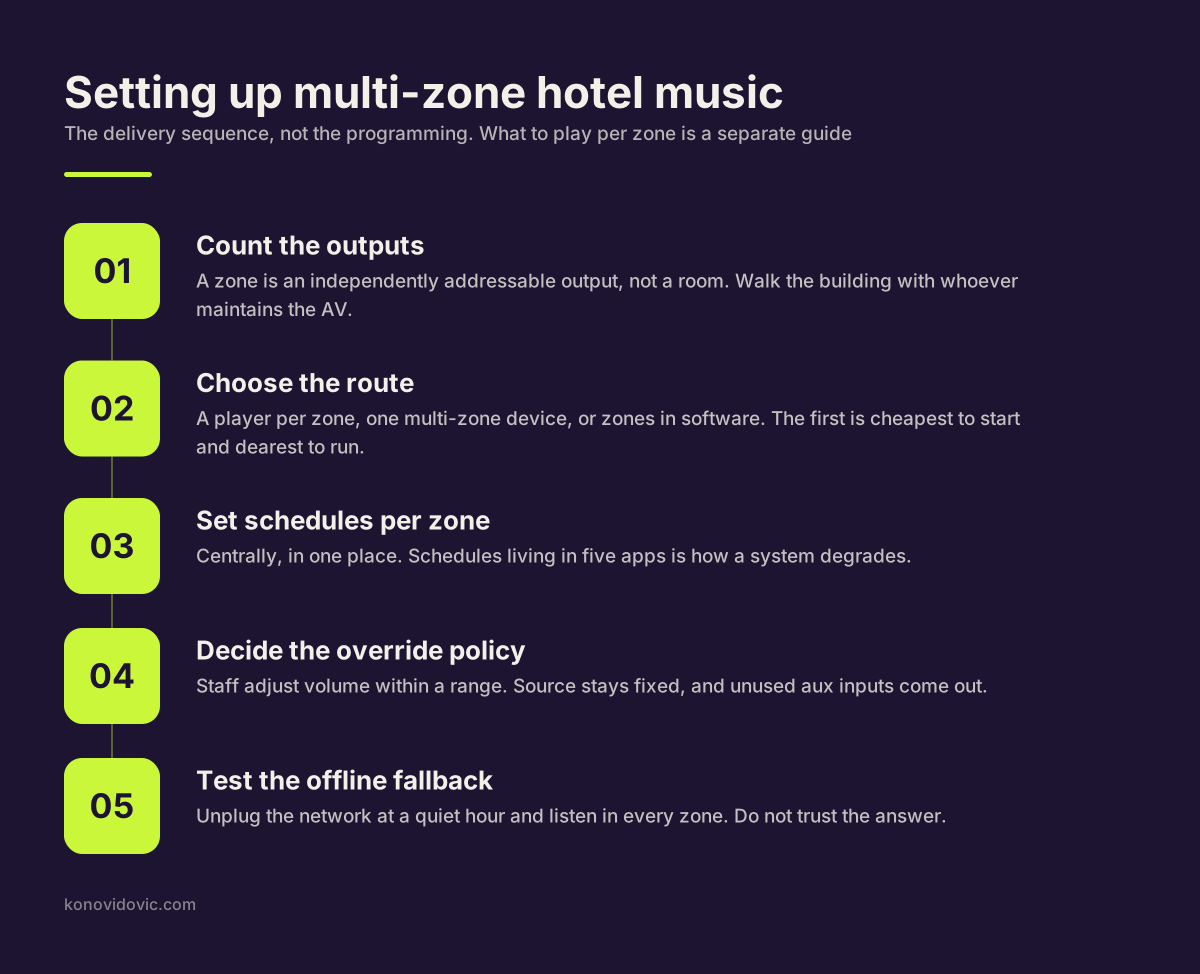
If the lobby and the lobby bar share one amplifier channel, they are one zone whatever the floor plan says, and you cannot give them different music without rewiring or adding a device. Conversely a large restaurant with separate breakfast and dinner areas on different channels is two zones and can run two different soundtracks.
So the first job is not musical. Walk the building with whoever maintains the AV and write down how many genuinely independent outputs exist today. Most properties find fewer than they assumed.
The Three Ways to Deliver It
What tends to work
- One multi-zone device or matrix feeding all areas
- Schedules set centrally, per zone, in one place
- Staff control limited to volume, within a set range
- A local fallback that plays when the line drops
- One named owner for the whole system
What causes the call-outs
- A separate consumer device hidden behind each bar
- Schedules living in five different apps
- Full control at every zone, including source
- Cloud-only delivery with nothing cached
- Nobody owning it, so the AV contractor owns it by default
The three routes in practice:
- A player per zone. A device, a subscription or an account for each area. Cheapest to start, worst to run: five places to change a schedule, five things to go wrong, and five logins that leave with whoever set them up.
- One multi-zone device or matrix. A single source unit with multiple independent outputs, usually with its own scheduler. Higher up-front cost, dramatically lower running overhead, and the route I would choose for most full-service properties.
- Zones in software, via a commercial service. A B2B background music provider that addresses zones from one account. Convenient and the easiest to manage across properties, provided its zone handling actually matches your building.
That last proviso is the whole risk, and it is why the next section is a list of questions rather than a recommendation.
What to Ask Before You Buy
Ask about zones specifically, because “supports multiple locations” and “supports multiple zones inside one location” are different features and the words get used interchangeably.
The pricing question catches people out. A per-zone price turns a six-zone property into six line items, and that changes the comparison against a one-off multi-zone install considerably over three years.
The Offline Question
Ask what plays when the line drops, because the answer is sometimes nothing. A cloud-delivered service with no local cache means a silent lobby during an outage, and outages happen at the worst times.
What good looks like: each zone holds enough cached material to keep playing for hours, falls back to it automatically, and resumes the schedule when the connection returns. What to avoid: a system where an outage is audible to guests before it is visible to anyone on the staff side.
The Local Override Problem
This is what actually destroys multi-zone systems, and it is not technical. Somebody behind the bar plugs a phone into an aux input or brings in a Bluetooth speaker, and the zone you designed stops existing.
It happens for a reason: the music was wrong for the people standing in it, or nobody told them why it was chosen. The fix is partly social and partly a configuration decision.
- Restrict source, not volume. Let staff adjust level inside a set range and take away the ability to change what is playing. Volume is a legitimate operational need; source is not.
- Remove or disable the aux inputs that nobody has a reason to use, and know where every Bluetooth receiver in the building is.
- Brief the team, because a zone that gets overridden nightly is usually telling you the programming is wrong rather than that the staff are difficult. I have written about why staff decide whether an identity survives in sonic branding in hospitality.
Does Each Zone Need Its Own Licence?
No. Public performance licensing is a per-premises obligation, so adding a zone inside a building you already licence does not create a new licence.
What can change is the fee, because it is calculated from the characteristics of the premises rather than from the number of speakers. PPL PRS, which issues TheMusicLicence in the UK, states that the cost depends on the type of venue and how music is used, and that fees are calculated using measures such as “square meterage, number of employees, or venue capacity”. None of those is a zone count, but putting music into a space that previously had none can change the licensed area or the stated use, so tell your society what you have changed rather than assuming it is covered.
| Country | Societies | Licence route |
|---|---|---|
| Netherlands | Buma/Stemra and Sena | mijnlicentie.nl |
| UK | PPL and PRS for Music | TheMusicLicence via PPL PRS |
| Germany | GEMA and GVL | Separate, both required |
For a group with properties in more than one country the mechanics are different again, and I have set those out in music licensing across multiple locations. A provider’s subscription supplies a music source and may bundle certain rights; it does not discharge the public performance obligation for your premises, and neither does a prepared mix.
Key Takeaways:
- A zone is an independently addressable output, not a room. Count the outputs your building actually has before planning anything, because most properties have fewer than they assume.
- Three routes: a player per zone, one multi-zone device, or zones in software from a commercial provider. The per-zone route is cheapest to start and the most expensive to run.
- “Supports multiple locations” and “supports multiple zones in one location” are different features. Ask which, in writing, along with whether pricing is per zone or per premises.
- Ask what plays when the connection drops, then test it by unplugging the network at a quiet hour.
- Restrict what staff can change to volume rather than source, and treat a nightly override as evidence the programming is wrong.
Frequently Asked Questions
How do hotels stream different music to each public area?
By giving each area its own independently addressable audio output and feeding those outputs separately. In practice that is one of three arrangements: a separate player or subscription per zone, a single multi-zone device with several independent outputs, or a commercial background music service that addresses zones from one account. A full-service property typically needs four to six independent streams covering lobby, restaurant, bar, spa, gym and circulation areas.
How many music zones does a hotel need?
Four to six for a full-service property, and the number is set by how many areas genuinely need to sound different rather than by how many rooms exist. Corridors and lifts usually share one. A restaurant running breakfast and dinner in the same space is one zone with a schedule rather than two zones. Count the independent outputs first, because that is the constraint you will actually be working inside.
Can one subscription cover several zones in the same hotel?
Sometimes, and you have to ask specifically, because providers use “multiple locations” to mean separate sites and that is not the same as multiple zones within one site. Get the zone limit per site in writing, whether each zone can carry its own schedule rather than just its own playlist, and whether the price is per zone or per premises. A per-zone price changes the three-year comparison against a one-off multi-zone install considerably.
What happens to hotel music if the internet goes down?
It depends entirely on whether the system caches locally, and a cloud-only service with nothing cached means silence. A well-configured zone holds enough material to keep playing for hours, switches to it automatically and resumes the schedule when the line returns. Do not take the answer on trust: unplug the network at a quiet hour and walk the zones.
How do I stop staff changing the music in a zone?
Restrict the source rather than the volume. Staff have a genuine operational need to adjust level, so give them that within a set range and remove the ability to change what is playing, along with any aux input nobody has a reason to use. Then brief the team, because a zone that gets overridden every night is usually telling you the programming is wrong for the people standing in it.
Does each zone need its own music licence?
No. Public performance licensing is a per-premises obligation, so adding a zone inside premises you already licence does not create another licence. The fee is calculated from the site’s own characteristics, and PPL PRS states those measures include square meterage, number of employees or venue capacity rather than a zone count. Putting music into a space that previously had none can change the licensed area or stated use, so tell your society what has changed.
Want the zones mapped and the soundtrack built for your property rather than specified in the abstract? Get in touch with the zone list and what your building can currently address, or read hotel music consultancy for what the engagement covers.