 Kono Vidovic
A multi-location music strategy is a written document that fixes the parts of your sound that must be identical at every site and names the parts each site may change. Everything that goes wrong across a group goes wrong at that boundary. Centralise too much and site managers quietly opt out; centralise too little and you have fourteen venues with fourteen unrelated soundtracks and one logo.
I have built this for groups and single properties both, and the difference is not musical, it is governance. The music decisions are the easy part. If you want that document produced for your group rather than described, that is what music strategy consulting is for. What follows is the model itself, so you can build it yourself if you would rather.
What Should Be Identical Across Every Site?
Three things, and only three: the written brief, the genre palette, and the volume ceiling. Fix those and a guest moving between your sites recognises the same brand. Fix more than those and you are writing rules your site managers will break.
- The brief. One page per brand, not per site: who the guest is, what the room should feel like, what the music is doing. Everything downstream is an argument about the brief, so the brief has to exist in writing.
- The palette. The artists, genres and production styles that are in, and the ones that are explicitly out. A list of exclusions is more useful than a list of inclusions, because it is what a manager checks against at eleven at night.
- The volume ceiling. A number per zone type, written down, not a vibe. This is the single most-ignored item on the list and the one that generates the most guest complaints.
Everything else is negotiable, and treating it as negotiable is what gets the fixed three respected.
What Should Each Site Be Allowed to Change?
Timing, tolerance and occasions. A site in a business district fills at different hours than one next to a station, and a strategy that pretends otherwise gets overridden locally within a month.
Central, non-negotiable
- The written brief and who the guest is
- The genre palette, including the exclusions
- The volume ceiling per zone type
- Who may approve a change, and how
- The refresh schedule
Local, within the brief
- Daypart start and end times
- How fast the energy climbs, within the palette
- Seasonal and local-event programming
- Which zones are in use on a quiet weekday
- Requests from regulars, inside the exclusions
The reason to write the local column down rather than leave it unsaid is that an unwritten permission gets used as a licence to do anything. A written one gets used as intended.
How Do You Roll It Out Without Breaking Anything?
Never everywhere at once. Pick one site, get it right, then let that site’s manager help you brief the next three.
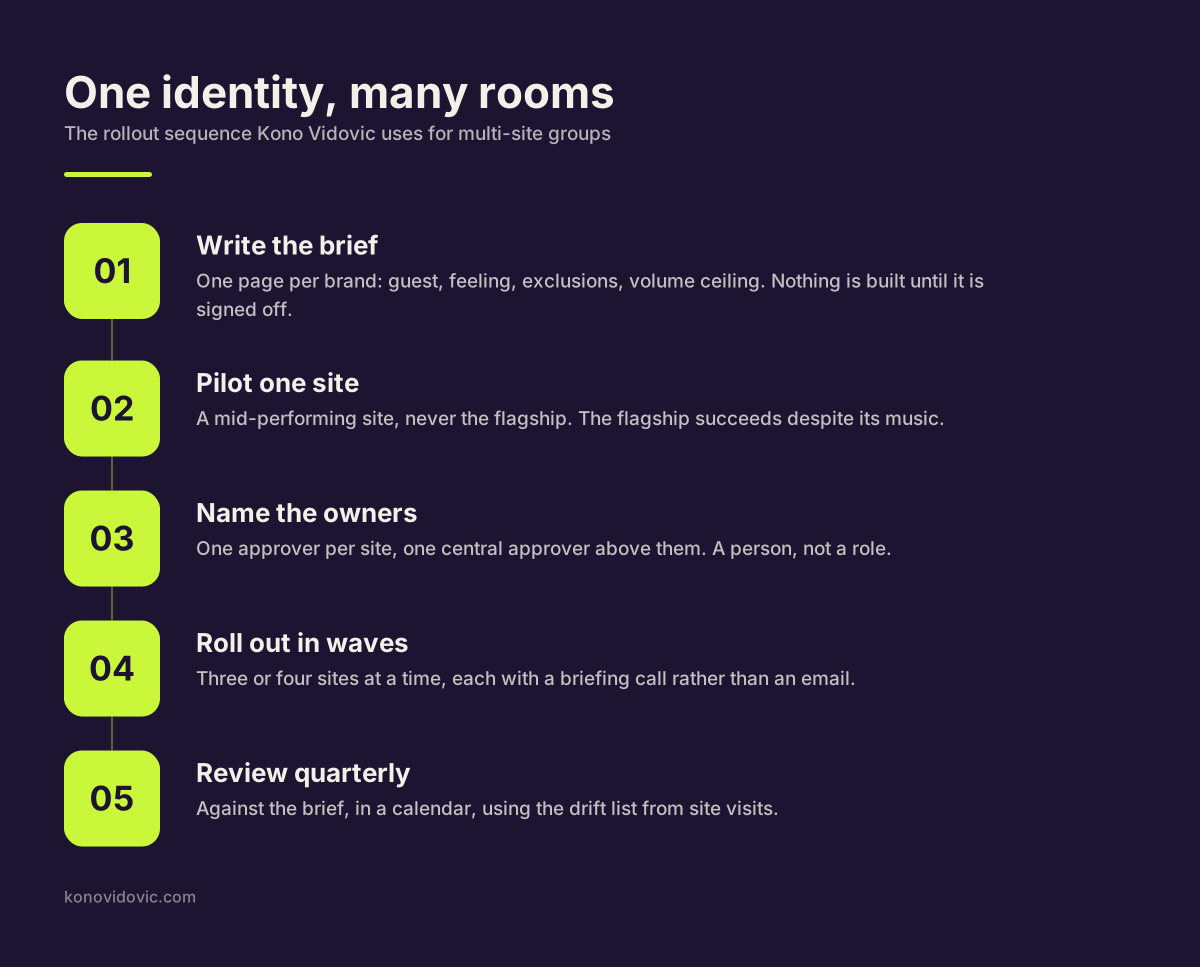
One page per brand. Guest, feeling, exclusions, volume ceiling. Nothing is built until this is signed off.
Choose a mid-performing site, not the flagship. The flagship succeeds despite the music and teaches you nothing.
One person per site who approves changes there, with one central approver above them. Not a role, a person.
Three or four sites at a time, each with a briefing call. A document emailed to twenty managers is a document nobody reads.
Against the brief, in a calendar, with the drift list from the site visits. Not when somebody complains.
The pilot matters more than anything else in that sequence. A strategy that has worked in one of your own rooms is a different conversation with site twelve than a strategy that has only worked in a slide deck.
What Changes When the Sites Are Franchised?
You lose the ability to mandate, so compliance has to be easier than non-compliance. With owned sites you can write music into the operating standard. With franchised sites you are persuading an independent business owner, and anything that costs them time will be dropped in the first busy week.
| Owned sites | Franchised sites | |
|---|---|---|
| How the standard lands | Written into operating procedure | Recommended, with a commercial argument attached |
| What you can require | Palette, ceiling, source and schedule | Realistically the palette and the brand name |
| What makes it stick | Audit and the line manager | Making the compliant option the fastest one |
| Who pays for the music | Usually central | Usually the franchisee, which changes the sell |
| The failure mode | Quiet substitution at site level | Open opt-out at renewal |
For franchised groups the thing that actually works is supplying the music ready to play, centrally produced, so that using it takes less effort than building a playlist. Nobody opts out of the easy path. Everyone opts out of homework.
What Does It Cost Across Many Sites?
The music source is a one-off or a subscription; the licence is per venue and recurs. Those are two different lines in the budget and groups routinely conflate them.
| Deliverable | Price | Unit |
|---|---|---|
| Custom mix, 60 minutes | EUR 249 | Per mix, one-off, excludes VAT where applicable |
| Custom mix, 90 minutes | EUR 349 | Per mix, one-off, excludes VAT where applicable |
| Custom mix, 120 minutes | EUR 449 | Per mix, one-off, excludes VAT where applicable |
| Music strategy consulting | Request a quote | Per brand, scoped on number of sites and zones |
| Public performance licence | Set by your collecting society | Per venue, recurring, never included above |
Centrally produced mixes are the one place where a group has a genuine cost advantage over a single venue. A mix commissioned once can play at every site that shares the brief, so the production cost divides across the estate while a per-location subscription multiplies by it. That advantage applies to the music source only. It does not touch the licence, which is the point of the next section.
How Do You Know a Site Has Drifted?
By visiting, because no dashboard tells you a room sounds wrong. Drift is the normal state of a multi-site soundtrack, not an exception, and the review cycle exists to catch it rather than to prevent it.
The access question is the one that predicts everything else. A site where four people can change the music has already drifted, whatever is playing on the day you visit. I have written about why that happens to a single playlist in my guide to business playlist strategy, and the effect compounds across an estate.
If the brand sound itself is still undecided rather than just inconsistently applied, that is an earlier problem, and my guide to sonic branding covers defining the identity before you try to govern it across sites.
Who Arranges the Licence for Each Location?
Each venue, separately, and a group licence does not replace that. Public performance licensing is a per-premises obligation, and the fee is set by the characteristics of the individual site, so it scales with your estate rather than consolidating down.
PPL PRS, the joint venture that issues TheMusicLicence in the UK, states that the cost depends on the type of venue and how music is used, and that fees are calculated using measures such as “square meterage, number of employees, or venue capacity”. Those are per-site measures. A fifteen-site group is fifteen separate calculations, and the answer differs between a 40-seat unit and a 300-seat one.
The societies to approach, by country:
| Country | Societies | Licence route |
|---|---|---|
| Netherlands | Buma/Stemra and Sena | mijnlicentie.nl |
| UK | PPL and PRS for Music | TheMusicLicence via PPL PRS |
| Germany | GEMA and GVL | Separate, both required |
| United States | ASCAP, BMI, SESAC and GMR | Separate licences, no joint venture |
| Canada | SOCAN and Re:Sound | Entandem |
| Australia | APRA AMCOS and PPCA | OneMusic Australia |
Commissioning a mix never supplies a licence, and a centrally produced mix does not reduce, bundle or simplify the obligation at any site. A mix is where the music comes from; the licence is permission to play music in public, and every one of your venues needs its own. If a central team is arranging licences on behalf of sites, confirm in writing which legal entity each licence names, because that is the detail that unravels at an inspection.
Key Takeaways:
- Fix only three things centrally: the written brief, the genre palette including exclusions, and the volume ceiling per zone. Write down what each site may change, or the unwritten permission becomes a licence to do anything.
- Pilot one mid-performing site before any rollout. The flagship succeeds despite its music and teaches you nothing.
- Name one owner per site with one central approver above them. A site where four people can change the music has already drifted.
- Franchised sites cannot be mandated, so the compliant option has to be the fastest one. Supply the music ready to play.
- The licence is per venue, priced on that venue’s own characteristics, and it never consolidates. A centrally produced mix is a music source, not permission to play it.
Frequently Asked Questions
What is a multi-location music strategy?
A written document that fixes which parts of your sound are identical at every site and names which parts each site may change. The fixed part is normally the brief, the genre palette and the volume ceiling. The flexible part is normally daypart timings, how fast the energy climbs, and seasonal or local-event programming. Without that boundary written down, either head office over-specifies and sites opt out, or nothing is specified and the brand sounds different in every room.
Can we use one playlist across all our locations?
One palette, yes. One identical playlist, rarely, because sites fill at different hours and a fixed sequence that fits a business-district lunch does not fit a site next to a station. The workable version is a shared source and brief with local control over timing only. That is also why centrally produced mixes suit groups: the same commissioned material plays everywhere, with each site deciding when.
Does a group need a separate music licence for each location?
Yes. Public performance licensing is a per-premises obligation and the fee is calculated from the individual site’s characteristics. PPL PRS states that TheMusicLicence fee depends on venue type and use, and is calculated on measures such as square meterage, number of employees or venue capacity, all of which are site-specific. Ask your own society directly: Buma/Stemra and Sena through mijnlicentie.nl in the Netherlands, PPL PRS in the UK, GEMA and GVL in Germany.
How is a franchise music strategy different?
You cannot mandate it, so it has to be easier to comply than not. With owned sites, music goes into the operating standard and a line manager enforces it. With franchisees you are persuading independent business owners who will drop anything that costs them time in the first busy week. Supply the music ready to play rather than asking them to build it, and attach a commercial argument rather than a brand instruction.
How often should a multi-site soundtrack be refreshed?
Quarterly as a review, with the refresh itself driven by what the review finds rather than by the calendar. Sampling what is actually playing at opening, peak and the last hour at each site will tell you whether the problem is stale material or local drift away from the brief. Those two problems have different fixes, and refreshing the music when the real issue is player access changes nothing.
Who should own music decisions across a group?
One named person per site who approves changes there, with a single central approver above them who owns the brief. Roles and departments do not work, because responsibility for the whole has to sit with someone specific. The access list is the test: if more people can change the music than are named as owners, the governance exists on paper only.
Want the brief, the flex rules and the rollout written for your group rather than described in the abstract? Get in touch with the number of sites and zones and I will scope it, or read music strategy consulting for what the engagement covers.


