 Kono Vidovic
Songs for a bar should be chosen by the hour, not by the song. A bar needs four distinct soundtracks across one night: early doors at roughly 85 to 100 BPM, a dinner crossover at 95 to 110, a peak at 110 to 125, and a last hour that comes back down to move people toward the door. Get that sequence right and the song list almost picks itself.
I have been behind the decks for 34 years, a good share of that in bars rather than clubs, and the mistake I see most often is a venue treating its soundtrack as a list instead of a shape. A 200-track playlist on shuffle will hit the right song at the wrong hour every single night. If you want the short version of the tempo logic, I have written it up separately in my guide to the right BPM for restaurant and retail music.
What Songs Should a Bar Play?
A bar should play music that matches the hour, the volume and the drink in people’s hands, drawn from a bounded set of genres that suit the room rather than from a chart list. The specific songs matter far less than most owners think. The sequence matters far more.
What actually decides the choice:
- The hour. The same track that lands at 22:30 kills the room at 17:30.
- The noise floor. An empty bar and a full bar are different acoustic spaces, so the same volume setting sounds wrong in both.
- Vocals and familiarity. Heavy recognisable vocals pull attention away from conversation. Early in the night that is a problem. At peak it is the point.
- The drink. A room drinking cocktails slowly and a room drinking pints quickly want different energy, which is why I set the genre palette by type of bar before choosing a single track.
- Your neighbours and your licence. Both set a ceiling you cannot design around.
How Does the Music Change Through the Night?
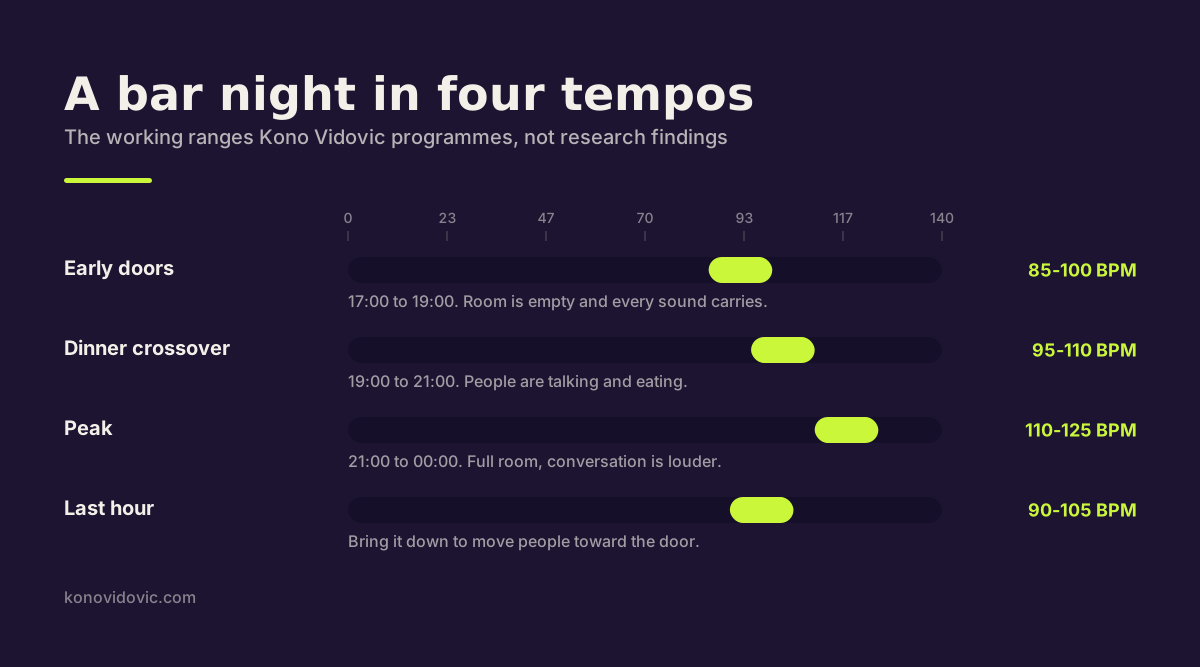
The music should move through four phases, each with its own tempo band, and the transitions between them should be gradual rather than stepped. These are the working ranges I programme. They are industry convention and my own practice, not a research finding.
| Phase | Typical hours | BPM band | What it is doing |
|---|---|---|---|
| Early doors | 17:00 to 19:00 | 85 to 100 | Makes an empty room feel occupied without shouting |
| Dinner crossover | 19:00 to 21:00 | 95 to 110 | Sits under conversation and food service |
| Peak | 21:00 to 00:00 | 110 to 125 | Carries a full, loud room and holds people in it |
| Last hour | from 00:00 | 90 to 105 | Signals the end without anyone announcing it |
The last row is the one venues skip. Dropping the tempo in the final hour empties a room far more gracefully than turning the lights up. People decide to leave on their own and they leave in a good mood, which is the difference between a last round and a last call.
Does the Music Actually Change What People Drink?
Yes, and the effect is well documented, though the honest version is narrower than the numbers that circulate online. Two findings are worth naming because they hold up.
- Milliman (1982), Journal of Marketing. Ronald Milliman’s supermarket field study showed that music tempo changes the pace at which people move through a space and the sales volume that follows. The direction is solid. The percentage figures attached to this study in blog posts vary wildly between retellings, so I do not quote one.
- North, Hargreaves and McKendrick (1999), Journal of Applied Psychology. French and German music played on alternate days beside a display of French and German wines shifted which country’s wine sold. Customers questioned afterwards had no idea the music had influenced them.
The second study is the one I would tattoo on every venue owner. The customers could not report the effect, which means customer feedback is a terrible instrument for judging a soundtrack. Judge it on dwell time, on second drinks, and on whether your staff can still take an order without leaning in.
How Loud Should a Bar Be?
Loud enough to feel occupied, quiet enough that two people at a table can speak without raising their voices. If your bartender has to ask customers to repeat an order, the music is too loud, and that is a service problem before it is a music problem.
There is a real finding here, and it is uncomfortable. Gueguen and colleagues, writing in Alcoholism: Clinical and Experimental Research in 2008, ran a field experiment in bars in western France with 40 male beer drinkers. They compared music at 72 dB, the venue’s normal level, with 88 dB. At the higher level patrons ordered more drinks and spent less time in the bar. The researchers offered two possible reasons: higher arousal making people drink faster, or the noise suppressing conversation so people drank because they were not talking.
I will be blunt about what that means. Turning the music up is a documented way to sell more alcohol faster. I do not programme for that, and I would push back on a brief that asked me to. A venue that empties and refills on volume is trading its regulars for turnover, and the regulars are the business. The useful reading of that study is the inverse: if your room is loud and nobody is talking, you are getting the effect whether you intended it or not.
What Should a Bar Never Play?
Some choices are wrong at any hour. This is the list I hand to venues:
- Anything with an ad break. A consumer streaming account will eventually play an advert in your room. It is also the wrong licence, which is the next section.
- Tracks the staff pick mid-shift. Staff choose by their own mood, not the room’s, and by hour three they are bored of anything that works.
- Chart hits that date the room. A bar that sounds like last summer looks like it has not been refreshed since.
- Anything with a sharp dynamic drop. A sudden quiet passage exposes the whole room and the conversation falls into the hole.
- Long instrumental deep cuts at peak. Save them for early doors, where they belong.
Do I Need a Music Licence for My Bar?
Yes. Any bar playing recorded music in public needs its own public performance licence, and a personal streaming subscription does not cover it because it is licensed for personal, non-commercial use only. What you need depends on the country.
In the Netherlands that is a combined Buma/Stemra and Sena licence, arranged through mijnlicentie.nl. In the UK it is TheMusicLicence from PPL PRS. In Germany you need both GEMA and GVL. In the United States there is no joint venture, so ASCAP, BMI, SESAC and GMR are separate licences.
This matters for what comes next, so I will state it plainly. A custom mix is a music source, not a licence. It changes where your music comes from. It does nothing to your public performance obligation, and any supplier who suggests otherwise is telling you something that is not true.
How Do I Build the Soundtrack Without a DJ?
Build it as four timed blocks rather than one playlist, then write down the rules so it survives the person who made it. Most bars cannot justify a DJ five nights a week, and they do not need one. They need the programming, not the performer.
- Block it by hour, using the four phases above, with each block long enough not to repeat inside a shift.
- Bound the genres. Name three or four you will use and two you will never use. Write them down.
- Fix the volume per block, as a number on the amp, not a feeling.
- Decide who may change it, and make that one person.
- Refresh quarterly, not weekly. The rules should outlive the tracks.
That last point is where a custom DJ mix from EUR 249 earns its keep: a properly sequenced two-hour block with the transitions built in, which is a different object from a playlist and behaves differently in a room. If you also serve food, the daypart logic carries straight over to my notes on music for restaurants.
Key Takeaways:
- Programme a bar by the hour, not by the song. Four phases, each with its own tempo band, beats any playlist on shuffle.
- The working ranges are 85 to 100 BPM early, 95 to 110 over dinner, 110 to 125 at peak, and 90 to 105 in the last hour. These are convention and practice, not research.
- Dropping the tempo in the final hour clears a room better than turning the lights up.
- Gueguen and colleagues found louder music in bars led to more drinks in less time. That is a lever I decline to pull, and a warning if your room is already loud.
- A custom mix is a music source and never a licence. Your bar still needs its own public performance licence, which varies by country.
Frequently Asked Questions
What songs should a bar play?
Music matched to the hour, the volume and the room, drawn from three or four genres you have deliberately chosen. The specific titles matter less than the sequence. A bar needs four soundtracks in one night, not one playlist, and the transition between them should be gradual.
What BPM should bar music be?
As a working convention I run 85 to 100 BPM at early doors, 95 to 110 across the dinner crossover, 110 to 125 at peak, and 90 to 105 in the last hour. These are industry practice and my own programming, not a research finding, and they shift with the room and the crowd.
Can I use Spotify in my bar?
Not a personal subscription. That is licensed for personal, non-commercial use only, so a bar needs its own public performance licence on top of whatever it uses as a music source: Buma/Stemra and Sena in the Netherlands, TheMusicLicence in the UK, GEMA and GVL in Germany, separate ASCAP, BMI, SESAC and GMR licences in the United States.
Does louder music make people drink more?
A 2008 field experiment by Gueguen and colleagues in bars in western France, published in Alcoholism: Clinical and Experimental Research, compared music at 72 dB with 88 dB and found patrons at the higher level ordered more drinks and spent less time in the bar. I do not treat that as a tactic. I treat it as a reason to check your volume.
How often should a bar change its music?
Refresh the tracks quarterly and keep the rules fixed for years. Weekly changes mean nobody is programming, they are just fiddling, and the room never develops a recognisable sound.
Should staff be allowed to change the music?
One named person should hold that permission, and it should not be whoever is nearest the tablet. Staff pick by their own mood rather than the room’s, and by the third hour of a shift they are tired of exactly the tracks that are working.
Want a soundtrack built for your room and your hours rather than a playlist? Order a custom DJ mix or get in touch and we will start with what your bar sounds like at 17:30.