 Kono Vidovic
Retail store music comes down to four routes: a consumer streaming account, which is not licensed for commercial use; a commercial background music service, which bundles some rights and charges per location per month; a custom mix built for your store, which is a one-off cost; or live programming, which almost no shop needs. Whichever you pick, you also need a public performance licence, and that is a separate purchase from the music itself.
I have spent 34 years choosing music for commercial spaces, and the mistake that costs retailers most is not picking the wrong genre. It is buying a music source and assuming it settled the licence question, or paying a monthly fee for years for something a one-off would have covered. If you want the behavioural side rather than the buying side, I have written that up in the power of music in retail.
What Are My Options for Retail Store Music?
There are four, and they differ on cost structure far more than on sound quality. Most retailers compare them on price per month and miss that two of them are not monthly at all.
| Route | What it is | Cost shape | Best for |
|---|---|---|---|
| Consumer streaming | A personal Spotify or Apple Music account | Low monthly, but not licensed for commercial use | Nothing commercial. See the licence section |
| Commercial music service | A B2B provider such as Soundtrack Your Brand, Mood Media or Epidemic Sound | Per location, per month, ongoing | Chains needing coverage across many sites with minimal effort |
| Custom mix | Sequenced audio built to your brief, which you own | One-off per mix | Single stores and small groups wanting a specific sound |
| Live programming | A DJ or curator in the room | Per session | Launches, events, flagship moments. Not a trading day |
The honest comparison is between the middle two, because the first is not a legitimate option and the fourth is not a daily one.
A commercial service gives you a very large catalogue, scheduling tools and someone else’s curation. You pay for it every month for as long as you trade, and the curation is built for a segment rather than for your shop. A custom mix gives you a soundtrack designed around your actual brand and trading hours, which you pay for once and own, but it does not refresh itself and it does not come with a dashboard.
Do I Need a Licence, and Does My Provider Cover It?
Yes, you need one, and whether your provider covers it depends entirely on the provider and the country. This is the part of the decision that retailers get wrong most often, and it is worth getting in writing before you sign anything.
Playing recorded music in a shop is a public performance, which is a different thing from listening to music. It requires a licence from the relevant collecting societies, and those are national:
| Country | Societies | Licence name |
|---|---|---|
| Netherlands | Buma/Stemra and Sena | Arranged via mijnlicentie.nl |
| UK | PPL and PRS for Music | TheMusicLicence from PPL PRS |
| Germany | GEMA and GVL | Separate, both required |
| Canada | SOCAN and Re:Sound | Entandem |
| Australia | APRA AMCOS and PPCA | OneMusic Australia |
| United States | ASCAP, BMI, SESAC, GMR | No joint venture, separate licences |
Some commercial background music services do bundle certain rights in certain territories, which is a genuine part of what you are paying for. What exactly they cover varies by provider and by country, so ask them directly and get the answer in your contract: which licences are included, in which territories, and which ones remain yours. Do not accept “it’s all covered” as a verbal answer.
For a custom mix the position is simpler and I will state it plainly, because it is the opposite of what some suppliers imply. A custom mix is a music source, not a licence. It changes where your music comes from and does nothing to your public performance obligation. If you buy a mix from me, you still arrange your own licence.
What Does Retail Store Music Cost?
Costs split into the music itself, the licence, and the hardware, and they are three separate lines on your budget. Only the first is what most comparison pages talk about.
These are my published rates for the music, in euros, as of 2026:
| Deliverable | Price | Unit | Qualifier |
|---|---|---|---|
| Custom mix, 60 minutes | EUR 249 | Per mix, one-off | Excludes VAT where applicable |
| Custom mix, 90 minutes | EUR 349 | Per mix, one-off | Excludes VAT where applicable |
| Custom mix, 120 minutes | EUR 449 | Per mix, one-off | Excludes VAT where applicable |
| Ongoing curation programme | Indicative, request a quote | Per project | Depends on zones and refresh cadence |
| Public performance licence | Set by your collecting society | Per premises, per year | Not sold by me, arranged by you |
The number nobody puts on a comparison page is the multi-year one. A monthly commercial service is the right call when you need many sites covered and refreshed without anyone thinking about it. For a single store with a settled identity, a handful of custom mixes rotated across the week will usually cost less over three years and sound more like you. Run that arithmetic for your own store rather than taking either side’s word for it.
What BPM Should a Retail Store Play?
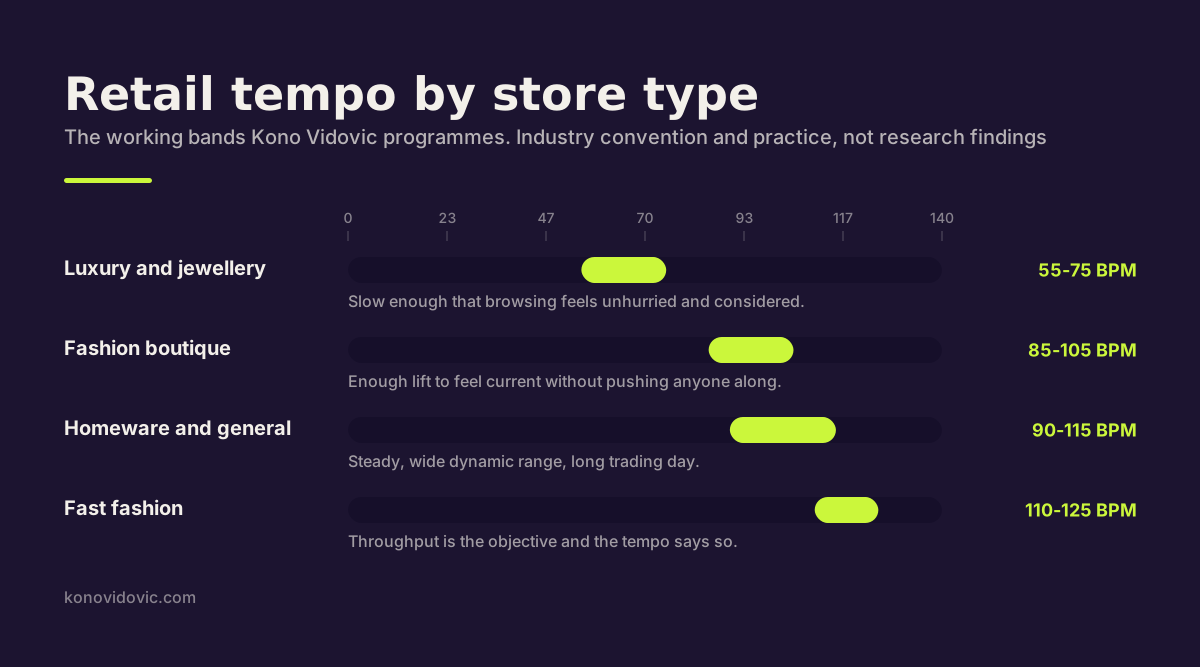
As a working convention I programme luxury and jewellery at 55 to 75 BPM, fashion boutiques at 85 to 105, homeware and general retail at 90 to 115, and fast fashion at 110 to 125. These are industry practice and my own, not research findings, and they move with the room and the hour.
What the research does support is congruence rather than any specific tempo. Areni and Kim’s 1993 field study in a wine store, published in Advances in Consumer Research, found shoppers selected more expensive merchandise when classical music played rather than Top-Forty. They did not buy more bottles, they bought dearer ones. North, Hargreaves and McKendrick, writing in the Journal of Applied Psychology in 1999, shifted which country’s wine sold by playing French or German music on alternate days, and shoppers questioned afterwards had no idea the music had influenced them.
Milliman showed in the Journal of Marketing in 1982 that tempo changes the pace at which people move through a space and the sales volume that follows. I cite these by direction and never by percentage, because the figures attached to them online vary wildly between retellings and trace back to blogs rather than papers. My full tempo reasoning is in what BPM to use for restaurant and retail music.
What Should I Ask Before Signing With a Provider?
Ask about exit, ownership and licence, in that order. Catalogue size is the thing every provider leads with and the thing that matters least, because no store plays more than a few thousand tracks a year.
What About the System Itself?
The system is usually simpler and cheaper than retailers expect: a source, an amplifier, and enough speakers that the volume is even rather than loud in one corner. The most common fault I find in shops is not the music, it is a room with two speakers doing the work of six.
- Zones. A shop with a fitting room, a till point and a browsing floor has three acoustic situations. One volume setting cannot serve all three.
- Speaker count. More speakers at lower volume beats fewer at higher volume, every time. It is also cheaper than most people assume.
- A fixed source. A tablet behind the counter invites staff to change it. A dedicated player does not.
- Volume by daypart, written down. As a number on the amplifier, not a feeling. Opening, midday and the last hour are different rooms.
Key Takeaways:
- Four routes exist: consumer streaming, which is not licensed for commercial use, a commercial service billed monthly per site, a one-off custom mix you own, or live programming for events.
- Your public performance licence is a separate purchase from your music source, and the societies are national: Buma/Stemra and Sena, PPL PRS, GEMA and GVL, and others.
- Some commercial services bundle certain rights in certain countries. Get in writing which ones, where, and what stays yours.
- A custom mix is a music source and never a licence.
- Working tempo bands run from 55 to 75 BPM for luxury up to 110 to 125 for fast fashion. These are convention and practice, not research.
Frequently Asked Questions
Can I use Spotify in my retail store?
Not a personal subscription. It is licensed for personal, non-commercial use only, so using it in a shop breaches those terms and still leaves you without the public performance licence a commercial premises separately needs. Spotify does offer a business product, and there are dedicated commercial providers, but you need to check what each one covers in your country.
How much does retail store music cost?
The music itself is either a monthly fee per location with a commercial service, or a one-off with a custom mix, which starts at EUR 249 for 60 minutes and runs to EUR 449 for 120. Your public performance licence is a separate annual cost set by your national collecting society, and hardware is a third line.
Does a music service include my licence?
Sometimes, partly, and it depends on the provider and the country. Some commercial services bundle certain rights in certain territories. Ask which licences are included, in which countries, and which remain yours, and get that answer in the contract rather than from a sales page.
What BPM should retail music be?
As a working convention: 55 to 75 BPM for luxury and jewellery, 85 to 105 for fashion boutiques, 90 to 115 for homeware and general retail, and 110 to 125 for fast fashion. These are industry practice and my own programming rather than a research finding.
Is a custom mix better than a subscription?
For a single store with a settled identity, usually yes, because you pay once, own it, and it sounds like your brand rather than a segment. For a chain needing many sites covered and refreshed with minimal effort, a commercial service is the better fit. The deciding factor is how many locations you run, not the monthly price.
How often should retail music be refreshed?
Rotate the music quarterly and keep the rules fixed for years. A shop that changes its sound every few weeks never develops a recognisable one, and a shop that never changes it starts to feel stale to staff long before customers notice.
Want a soundtrack that sounds like your shop rather than like a category? Order a custom DJ mix from EUR 249, or get in touch and tell me what your floor sounds like at midday.


