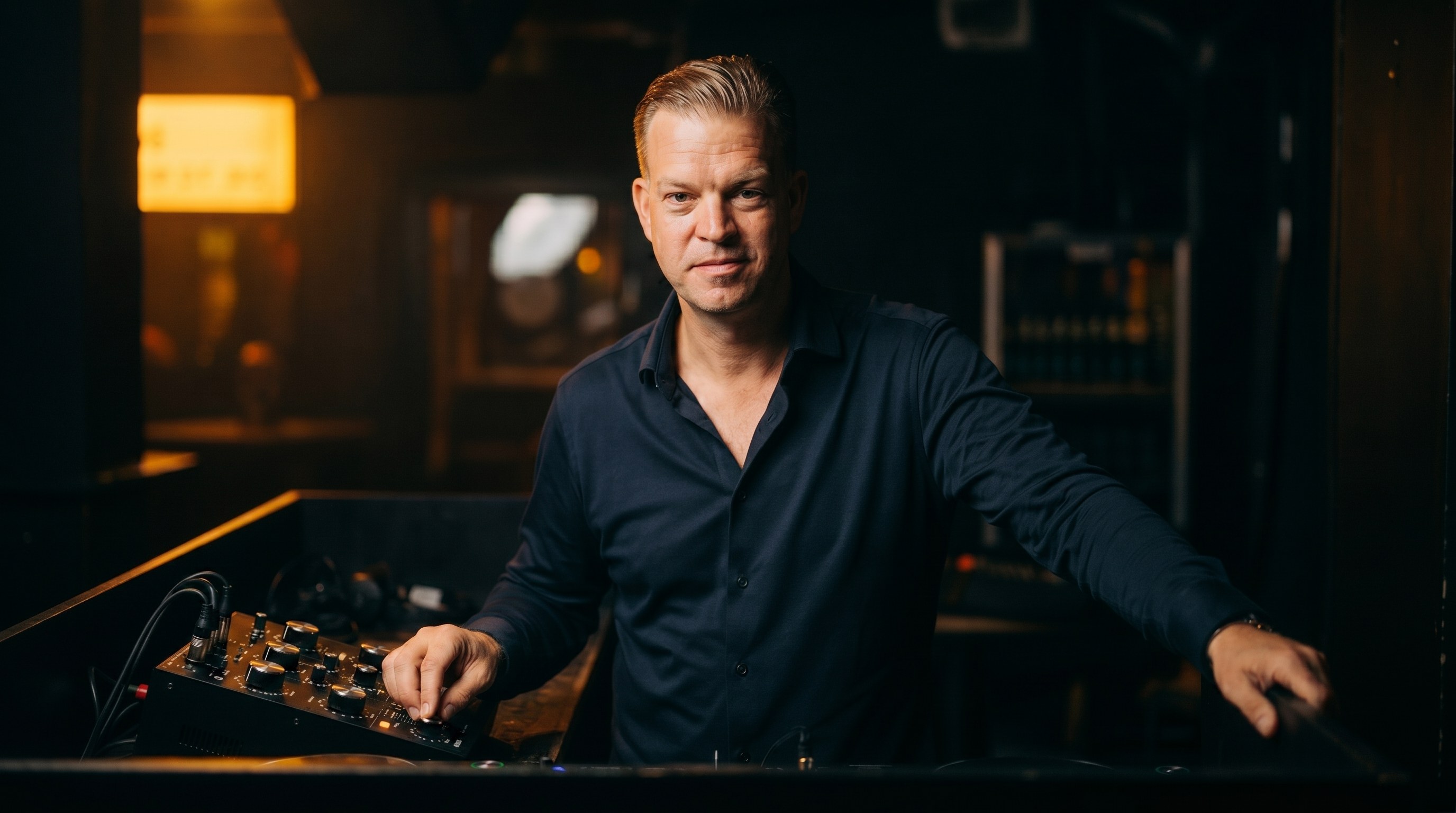
 Kono Vidovic
Sonic branding is the deliberate use of music and sound to build a brand identity, covering everything a brand is heard through: the music in its spaces, its sound marks in film and digital products, and the moments where it chooses silence. Most brands invest heavily in what they look like and almost nothing in what they sound like. After 34 years as a DJ, curator and music consultant, I can tell you the brands with the strongest emotional hold on their customers are almost always the ones that were as deliberate about music as they were about their logo.
If you want to start building a sound for your brand, music strategy consulting is exactly what I do. This article gives you the framework to understand what you are building toward.
What Sonic Branding Actually Is
Sonic branding is the deliberate, strategic use of music and sound to communicate brand identity, values and personality. It is the audio equivalent of a visual identity system - just as a brand has defined colours, typography and logo usage rules, a sonic brand defines what the brand sounds like across every touchpoint.
This definition matters because sonic branding is frequently confused with background music or a jingle. It is neither. A jingle is an advertising tool. Background music is an operational decision. Sonic branding is a strategic framework that informs both - and extends far beyond them.
A complete sonic identity covers:
- Brand music guidelines - the genre palette, tempo ranges, instrumentation, mood vocabulary and what to avoid
- A sonic logo - a short, distinctive audio signature (3-7 seconds) that identifies the brand
- Voice and tone - the character of any brand voice or narration
- Environmental music - how the brand sounds in physical spaces
- Digital touchpoints - notifications, loading sounds, UI audio, video content music
- Advertising music - the sonic frame for campaigns
Not every brand needs all of these. Most businesses need to start with the environmental and guidelines layer, which is where the day-to-day customer experience happens.
Why Sound Works So Differently to Visual Branding
The brain processes sound differently to visual information. Auditory stimuli reach the limbic system - the part of the brain responsible for emotion and memory - faster and more directly than visual stimuli. This is why a piece of music can trigger a memory or an emotion almost instantaneously, before the conscious mind has even processed what is playing.
This has direct commercial implications. A brand that has established a consistent sonic identity creates a conditioned emotional response over time. Customers do not need to consciously think about the music - they simply feel something. That feeling becomes associated with the brand.
Research consistently demonstrates the business impact. A 2020 study by Nielsen found that audio advertising significantly outperforms visual formats on key brand metrics including recall, purchase intent and emotional engagement. The data is not surprising to anyone who has spent time studying how music shapes human behaviour - but it still catches most brand managers off guard when they see the numbers.
The Difference Between Sonic Branding and Playing Music
This distinction is important enough to address directly, because I see it misunderstood constantly.
Playing music is a binary decision: is there music, or is there silence? Most businesses make this decision reactively - someone puts on Spotify, connects to a radio station, or asks the kitchen staff to sort something out. The music is there. The decision has been made. But it has been made with no strategic intent.
Sonic branding asks a different question: what should this brand sound like, and why? It starts with the brand - its values, its positioning, its target customer, the emotional experience it wants to create - and works backward to a musical brief. Every track, every tempo decision, every genre choice is tested against that brief.
Sonic branding
- Starts with brand strategy
- Defined genre palette and mood vocabulary
- Consistent across all touchpoints
- Tested against brand values
- Updated deliberately, not randomly
- Creates a recognisable brand feeling
Just playing music
- Reactive, operational decision
- No defined parameters
- Inconsistent across spaces and times
- Not connected to brand identity
- Changed based on staff preference
- Forgettable or actively damaging
The Elements of a Sonic Identity
Genre Palette
This is the foundation. A genre palette defines the musical territory your brand occupies. It is not a single genre - most brands have a range - but it is bounded. A luxury hotel might operate within deep house, jazz and ambient electronic. A premium fitness brand might work within hip-hop, electronic and afrobeat. A Scandinavian furniture brand might use Nordic folk, minimal techno and contemporary classical.
The palette needs to do two things simultaneously: feel appropriate to your brand, and feel appropriate to your customer. Getting this right requires genuine musical knowledge - understanding not just genre labels but the emotional register, the cultural associations and the tempo dynamics within each.
BPM Strategy
Tempo is one of the most commercially impactful variables in environmental music. Research going back to the 1980s (most notably the Milliman studies on retail and restaurant environments) has demonstrated that slower tempo music increases dwell time and spend, while faster music increases throughput. This is not a marginal effect - it is measurable and replicable.
A sophisticated sonic brand defines tempo ranges by daypart and by commercial objective. A restaurant that wants to increase table occupancy at lunch uses different tempo parameters than the same restaurant on a Friday evening when the objective is to extend the experience and increase beverage spend.
| Context | BPM range | Commercial objective |
|---|---|---|
| High-end retail browsing | 60-80 BPM | Extend dwell time, increase basket size |
| Restaurant lunch service | 85-100 BPM | Efficient service, table turnover |
| Restaurant dinner (peak) | 65-80 BPM | Extended experience, higher spend per cover |
| Hotel lobby (arrival) | 70-90 BPM | Welcoming, unhurried first impression |
| Fitness studio (warm-up) | 100-120 BPM | Energy building |
| Spa / wellness | 50-70 BPM | Relaxation, slowed perception of time |
Mood Arc
Music creates emotional narrative over time. A venue that plays the same energy level from opening to close is missing the opportunity to shape the customer experience through time. A well-designed sonic brand defines a mood arc for each daypart - how the energy builds, plateaus and shifts across a service period.
This is one of the areas where a professionally mixed set creates a significant advantage over a playlist. A DJ mix can be engineered to follow an exact mood arc, with transitions designed to feel seamless. A shuffled playlist is random.
What to Avoid
This is underrated. Every sonic brief should include a clear list of what the brand should never sound like - the genres, artists, tempos and moods that would undermine the positioning. This is often easier to define than what you want, and it is equally important for maintaining consistency.
How to Build a Sonic Identity: The Process
Before any music decisions are made, I need to understand the brand: its values, its positioning, its target customer, and the emotional experience it is trying to create. I also audit the current music situation - what is playing now, and what problems it is creating or missing.
The brief translates brand strategy into musical parameters: genre palette, BPM ranges by context and daypart, mood vocabulary, reference tracks and artists, and what to avoid. This document is the strategic foundation that everything else is built on.
I build a prototype playlist or mix based on the brief and test it in the actual environment. Real spaces sound different from headphones. We listen, observe and refine before committing to production.
Custom DJ mixes are produced for the primary use cases - typically different dayparts or zones. The brief governs every track selection and every transition. This is not curation by feel; it is curation by brief.
The final deliverable includes the sonic brand guidelines document - a written record of the genre palette, parameters, references and rules. This means the brand can maintain consistency over time, even as personnel changes and new spaces open.
Who Sonic Branding Is For
The common misconception is that sonic branding is only for major global brands - the Intel bong, the McDonald’s “I’m Lovin’ It” five notes, the Netflix ta-dum. These are sonic logos, and yes, they required significant investment. But the environmental and guidelines layer of sonic branding is accessible to any business that plays music in a customer-facing context.
The businesses that benefit most from a deliberate sonic identity:
Hotels and hospitality - where the music is on all day across multiple zones and the experience has to feel consistent and on-brand throughout. The lobby, the bar, the restaurant and the spa cannot each be doing their own thing musically.
Independent restaurants and cafes - where differentiation from chains and generic competitors often comes down to atmosphere, and atmosphere is largely musical.
Retail - where music directly influences browsing behaviour, dwell time and purchase decisions in ways that are well-documented in the research literature, and where sonic branding for luxury brands runs on restraint rather than energy.
Agencies and brand studios - building a sonic brief for a client is increasingly part of a complete brand identity project. Most design and strategy agencies do not have this capability in-house.
Independent artists and labels - music strategy consulting for artists includes helping them define and communicate their sonic identity in contexts beyond recorded music.
Wellness and hospitality - spas, gyms, yoga studios and wellness brands where the sensory environment is central to the service proposition.
What the Research Actually Supports
The research on music and consumer behaviour goes back four decades and supports one clear conclusion: music that fits the setting changes what people choose and how long they stay. It does not support any specific percentage uplift, and the figures that circulate online have usually been laundered through several blog posts before they reach you.
Here is what holds up, cited by direction rather than by a number I cannot trace:
- Milliman (1982), Journal of Marketing. A supermarket field study showed that music tempo changes the pace at which people move through a space, and the sales volume that follows.
- Milliman (1986), Journal of Consumer Research. The same question in a restaurant: tempo changed how long patrons stayed and what they ordered.
- North, Hargreaves and McKendrick (1999), Journal of Applied Psychology. French and German music played on alternate days beside a display of French and German wines shifted which country’s wine sold. Customers questioned afterwards had no idea the music had influenced them.
- Krishna (2012), Journal of Consumer Psychology. Her review of sensory marketing describes sensory cues acting as subconscious triggers that shape how people perceive abstract qualities such as sophistication and quality.
I deliberately quote no percentages for any of these. The numbers attached to Milliman in particular vary wildly between retellings, and I have seen a 9% uplift and a 32% dwell-time increase presented as settled fact on pages that cite no study at all. If a supplier quotes you a precise percentage for what music will do to your revenue, ask them for the paper. The honest answer is that the direction is well established and the magnitude depends on your room.
Common Sonic Branding Mistakes
Volume too high or too low. Volume is part of the sonic brand. Music that is too loud forces raised voices, creates stress and shortens stays. Music that is too quiet feels like an afterthought. The right level varies by venue type and time of day - there is no universal correct answer, but there is a correct answer for each context.
Staff controlling the music. The music that makes your kitchen team happy at 11pm is not the music that serves your Friday dinner guests. Removing personal music decisions from the floor is one of the most impactful operational changes a hospitality business can make.
Using the wrong tempo for the time of day. Playing high-energy music at a lunch service designed for quick turnover, then the same music during a slow Friday evening when you want guests to linger and order another round. BPM strategy should be explicit and scheduled, not left to chance.
Inconsistency across spaces and occasions. A hotel with a different music approach in every space feels fragmented and cheap, regardless of the quality of the other elements. Consistency creates the feeling of intentionality.
Updating the music randomly. Sonic brands should evolve, but deliberately - seasonally, with major brand refreshes, or when the customer profile changes. Not because someone felt like a change.
Key Takeaways:
- Sonic branding is the strategic use of music and sound to build brand identity - not a jingle, not background music
- Sound reaches the emotional brain faster than visual information, making it a powerful brand tool
- A complete sonic identity includes genre palette, BPM strategy, mood arc and documented guidelines
- The business impact is measurable: dwell time, spend per visit and brand perception all respond to music
- Any customer-facing business that plays music can benefit from a deliberate sonic strategy
- The gap between brands that have thought about their sound and those that have not is immediately perceptible to customers
Frequently Asked Questions
What is the difference between sonic branding and audio branding?
The terms are used interchangeably in most professional contexts. Sonic branding tends to be used more broadly, covering the full strategic framework including environmental music and brand guidelines. Audio branding sometimes refers more specifically to the production of sonic logos and brand audio assets. In practice, any professional working in this space will understand both terms.
Do I need a sonic logo to have a sonic brand?
No. A sonic logo - the short audio signature that identifies a brand - is one element of a complete sonic identity, but it is not the most important one for most businesses. Environmental music guidelines, BPM strategy and a documented genre palette deliver the majority of the commercial impact. A sonic logo becomes valuable once the broader identity is established and you need a distinctive audio mark for advertising and digital contexts.
How long does it take to develop a sonic brand?
A discovery call and initial brief typically takes one to two weeks. The full development process - from brief to documented guidelines and first mix deliverables - usually runs four to six weeks depending on the complexity of the brand and the number of environments involved. Simpler projects can move faster.
Can small businesses afford sonic branding?
Yes. The full agency sonic branding process - research, sonic logo production, full guidelines documentation, brand testing - can be expensive when done at scale. But the core of what makes sonic branding work is the strategic thinking and the musical knowledge, not the size of the production budget. A custom DJ mix from €249 built to a proper brief is sonic branding in practice, even if the full guidelines document comes later. Most clients start with one or two mixes and build the broader strategy over time.
How much does sonic branding cost?
My own work starts at €350 for a music strategy and audit, €249 for a single custom mix built to a brief, and from €800 for a documented sonic identity with written guidelines. Four things move the price: how many touchpoints need covering, whether you need a written document or just the output, whether a sonic logo is involved, and how many locations have to stay consistent. Very few agencies publish figures at all, so treat any single number you find online with caution. One cost is never included, by me or anyone else: your own public performance licence, which you register for in your own country.
How do I brief a music consultant on sonic branding?
Start with your brand positioning: who you are, who your customer is, and the emotional experience you want to create. Add reference points - brands you admire, spaces you find inspiring, music that feels right and music that feels completely wrong. The musical expertise is my job; your job is to communicate the brand clearly. The more specific you can be about values and customer experience, the better the musical output.
How often should a sonic brand be updated?
The core framework - genre palette, guidelines, strategic parameters - should be stable for years, evolving with the brand rather than reacting to trends. The content within that framework - specific mixes, playlists, seasonal variations - should refresh regularly. For venues with regular returning customers, I recommend refreshing primary mixes every one to three months. Seasonal programming shifts (summer to autumn, for example) are an opportunity to update the mood without changing the underlying identity.
What makes Kono’s approach to sonic branding different?
I have been working with music professionally for over 34 years, across DJing, curation, radio and consulting. I understand music deeply - not just genre labels but tempo dynamics, emotional register, cultural context and how music moves across time. That is different from a brand strategist who learned music theory, or a graphic designer who added sound to their service offering. The strategic thinking and the musical execution come from the same place, which is unusual in this space. Get in touch if you want to understand what that looks like in practice.
A sonic identity is a document before it is a playlist, and the document is what survives the person who made it. That is the work I do as music strategy consulting, with the custom mixes built to it afterwards. Book a free discovery call and we will start with what your brand sounds like now.


