 Kono Vidovic
Sonic branding in retail has to work in about four minutes, on somebody who is not listening. That is the whole brief. A hotel guest hears your identity across a thirty-six hour stay and a shopper hears it while looking at a jumper and deciding whether to queue, so a retail identity has to be legible almost immediately or it does not register at all.
I programme for retail as well as hospitality, and the two are near opposites. If you want the identity defined for your stores rather than described, that is what music strategy consulting is for. What follows is what changes when the brand gets minutes instead of days, and it is deliberately not a repeat of the behaviour research or the tempo bands, both of which are already written up elsewhere on this site.
What Makes Sonic Branding in Retail Different?
Short exposure and divided attention. Every other sector gets at least one of those in its favour and retail gets neither.
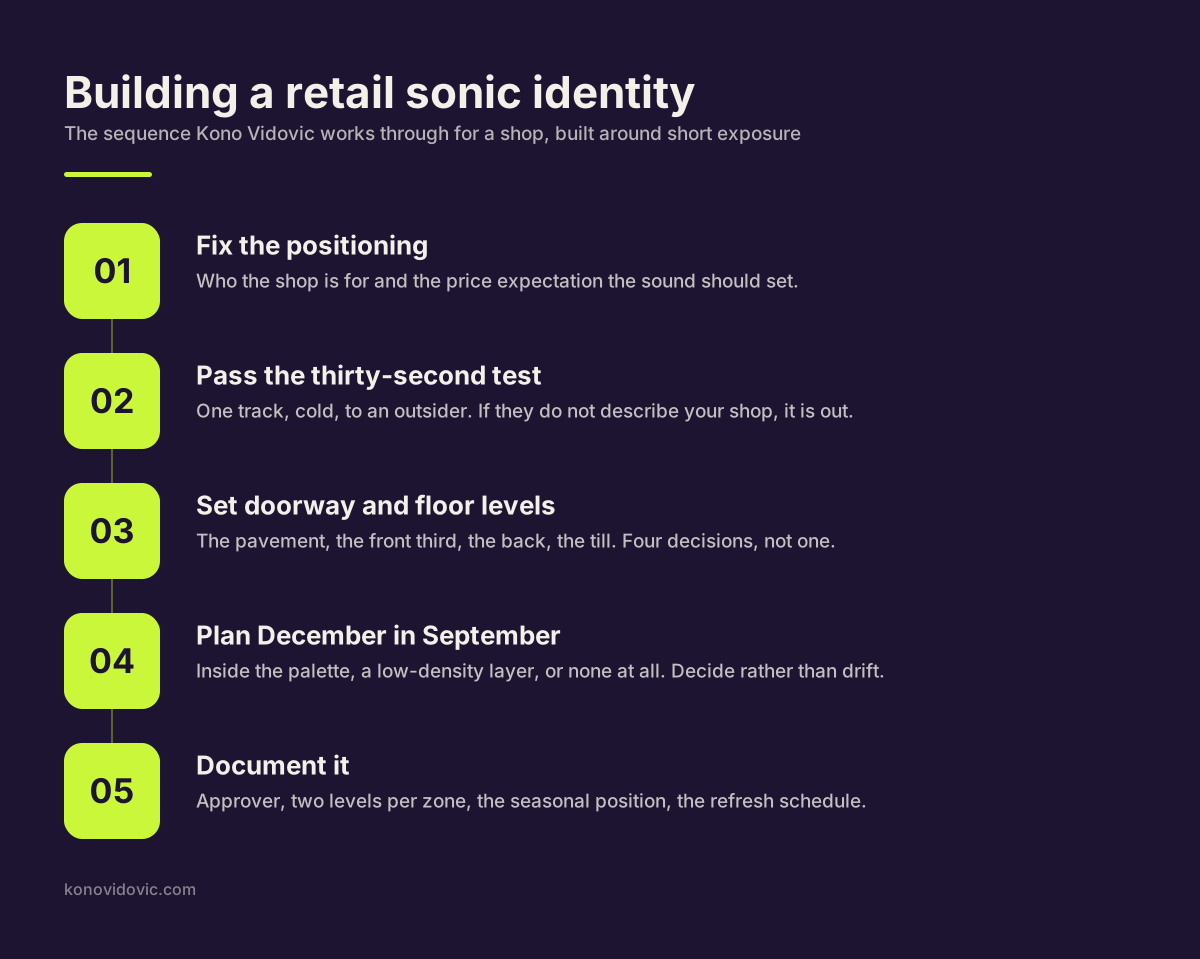
The consequences run the opposite way to hospitality, where the problem is lasting thirty-six hours without repeating:
- The opening is the whole identity. A shopper who is in and out in four minutes hears one or two tracks. Whatever those are, that is your brand that day.
- Nobody is listening on purpose. The music is competing with product, price labels, other shoppers and a phone. It has to work as a background signal rather than a foreground statement.
- Depth of catalogue matters much less than it does in hospitality, because almost no customer hears the rotation twice. It matters for your staff, which is a separate problem I have written up in how retail music influences buying behaviour.
That inversion is why a hospitality soundtrack dropped into a shop usually feels flat, and why a retail soundtrack in a hotel feels relentless by the second evening.
The Thirty-Second Test
Play any track from your rotation to somebody who does not know the brand and ask them to describe the shop. If what they describe is not your shop, the track does not belong in the rotation.
That sounds crude and it is the most useful filter I know for retail. It works because it tests the thing that actually happens: a single track heard cold, with no context and no attention.
- Run it on the whole rotation, not a sample. The weak tracks are the ones nobody chose deliberately, and they are exactly the ones a four-minute shopper will land on.
- Test the first thirty seconds of the track, not the chorus. Nobody in your shop will hear the chorus.
- Do it with someone outside the business. Anyone internal already knows the answer and cannot un-know it.
What Does the Doorway Sound Like?
It is the only part of your soundtrack that reaches people who have not decided to come in, and it is almost never designed.
Sound spills out of a retail doorway, and in a street of shops it is one of the few signals a passer-by gets before committing. The useful research here is about congruence rather than volume: Areni and Kim’s 1993 field study in a wine store, published in Advances in Consumer Research, found shoppers selected more expensive merchandise when classical music played rather than Top-Forty. Genre sets a price expectation. At the doorway that expectation is being set before anyone has seen a price tag.
| Where | What it is doing | What usually goes wrong |
|---|---|---|
| Pavement and doorway | Signalling who the shop is for, before entry | Set by whatever the floor level happens to be |
| Front third of the floor | Confirming the signal the doorway gave | Different character from the doorway, so the promise breaks |
| Back of the floor and fitting rooms | Holding people who have committed | Same level as the front, so there is no sense of arriving |
| Till and queue | Not adding stress to a wait | Loudest point in the shop, which is the wrong choice |
The fix is usually not a new playlist. It is a zone level and a speaker angle, decided deliberately rather than inherited from whoever installed the system.
Will It Work at Both Volumes?
A shop on a quiet Tuesday morning and the same shop on a Saturday afternoon are different acoustic rooms, and a soundtrack chosen in one will fail in the other.
Forty people talking absorb sound and raise the noise floor. Material with a lot of quiet detail disappears entirely, so the identity goes missing exactly when the most people are in the room. Meanwhile the same track that cuts through on Saturday is intrusive on Tuesday, when two customers can hear every word of it.
What this means in practice:
- Choose material with a narrow dynamic range for peak hours and let the detailed, sparser material carry the quiet ones.
- Write down a level for each state, not a single number. Two numbers, both deliberate.
- Check the identity survives the busy version. If the only thing audible at peak is a drum pattern, you do not have an identity at peak.
If you want the tempo side of this rather than the dynamics side, I have published the bands I programme in the right BPM for restaurant and retail music, and the systems and cost comparison sits in retail store music.
What Happens to Your Identity in December?
It gets overwritten, for about six weeks, every year, and almost nobody plans for it. This is the single largest gap I see in retail sonic branding and it is entirely predictable.
The usual sequence: a carefully built identity runs for ten months, then in the third week of November somebody switches on a generic festive playlist, and for a sixth of the year the shop sounds like every other shop on the street. The brand work is suspended at precisely the point when footfall and spend are highest.
There are three workable positions and the mistake is not choosing one:
Deliberate approaches
- Festive material inside your own palette, commissioned or curated to fit
- A seasonal layer at low density, a few tracks an hour rather than all of them
- No festive music at all, as a stated brand position
- Decided in September, written into the guidelines
What usually happens
- A generic playlist switched on in week three of November
- Full density from day one, so staff are sick of it by December
- The identity suspended for the highest-traffic weeks of the year
- Decided by whoever is on shift that morning
Choosing not to play festive music is a legitimate brand position and some retailers hold it well. Drifting into the generic version without deciding is not a position, it is an accident that happens annually.
What Does It Cost?
| Deliverable | Price | Unit |
|---|---|---|
| Custom mix, 60 minutes | EUR 249 | Per mix, one-off, excludes VAT where applicable |
| Custom mix, 90 minutes | EUR 349 | Per mix, one-off, excludes VAT where applicable |
| Custom mix, 120 minutes | EUR 449 | Per mix, one-off, excludes VAT where applicable |
| Sonic identity and strategy | Request a quote | Per brand, scoped on stores and zones |
| Public performance licence | Set by your collecting society | Per premises, recurring, never included above |
Retail spends less than hospitality on catalogue depth, for the reason above, and should spend more on the seasonal layer, because that is six weeks of the year rather than an afterthought.
Music Licensing Is Separate from Your Sonic Identity
Your sonic identity is what your shops sound like. Your licence is permission to play recorded music in public, and no amount of brand work supplies it.
Public performance licensing is a per-premises obligation, so a chain is as many licences as it has shops, and the fee is set by each site’s own characteristics. PPL PRS, which issues TheMusicLicence in the UK, states that the cost depends on the type of venue and how music is used, and that fees are calculated using measures such as “square meterage, number of employees, or venue capacity”.
| Country | Societies | Licence route |
|---|---|---|
| Netherlands | Buma/Stemra and Sena | mijnlicentie.nl |
| UK | PPL and PRS for Music | TheMusicLicence via PPL PRS |
| Germany | GEMA and GVL | Separate, both required |
| United States | ASCAP, BMI, SESAC and GMR | Separate licences, no joint venture |
Commissioning an identity never supplies a licence and neither does buying a prepared mix. A consumer streaming subscription does not cover commercial use at all, whatever the music on it sounds like.
Key Takeaways:
- Retail sonic branding gets about four minutes of exposure from a shopper who is not listening, which is the opposite of hospitality, so the opening of a track matters more than the depth of the catalogue.
- Use the thirty-second test: play one track cold to an outsider and ask them to describe the shop. If it is not your shop, the track does not belong.
- The doorway is the only part of the soundtrack heard by people who have not come in, and genre sets a price expectation before anyone sees a price.
- A quiet Tuesday and a Saturday peak are different acoustic rooms. Write down two levels and check the identity still survives the busy one.
- December overrides the identity for six weeks every year. Decide the position in September or it gets decided by whoever is on shift.
Frequently Asked Questions
What is sonic branding in retail?
The deliberate design of what a shop sounds like, built for short exposure and divided attention. It differs from sonic branding in hospitality mainly in duration: a shopper hears one or two tracks in a few minutes while looking at product, so the identity has to be legible almost immediately, where a hotel guest hears the identity across a whole stay and the problem is variation rather than first impressions.
How is it different from just choosing a good playlist?
A playlist is a list of tracks somebody liked. An identity is a written position on what the brand sounds like, with a level per zone, a rule for the doorway, a plan for December and a named person who approves changes. The test is whether a stranger hearing one track cold would describe your shop.
Does the music outside my shop door matter?
It is arguably the most important thirty seconds you have, because it reaches people who have not chosen to come in. Most retailers have never stood on their own pavement and listened. Genre at the doorway sets a price expectation before a customer has seen a single price, which is the practical reading of the congruence research.
Should retail music change at busy times?
The level should, and so should the kind of material. Forty people talking raise the noise floor and swallow anything with quiet detail, so material that carries the identity on a quiet morning can vanish at peak. Choose narrower dynamic range for busy hours, write down a level for each state, and check that something recognisable as your brand is still audible when the shop is full.
What should a retailer do about Christmas music?
Decide in September, and write the decision into the guidelines. There are three defensible positions: festive material commissioned or curated inside your own palette, a low-density seasonal layer of a few tracks an hour, or no festive music at all as a stated position. What does not work is switching on a generic playlist in November, which suspends the brand for the six highest-traffic weeks of the year.
Do I need a licence for each shop?
Yes. Public performance licensing is a per-premises obligation, so a chain needs a licence per site and the fee is calculated from each site’s own characteristics. Commissioning a sonic identity does not supply one, buying a prepared mix does not supply one, and a consumer streaming subscription does not cover commercial use. In the Netherlands that means Buma/Stemra and Sena through mijnlicentie.nl, in the UK TheMusicLicence from PPL PRS.
Want the doorway, the two levels and the December position decided for your stores rather than left to chance? Get in touch with the number of shops and zones, or read music strategy consulting for what the engagement covers.


