 Kono Vidovic
Professional curators choose tracks for a venue by auditioning them in the room rather than on headphones, and by rejecting most of what they audition. The selection is not a hunt for good music. It is a hunt for music that does one specific job, in one specific space, at one specific hour, which is a far narrower target and the reason my reject pile is always longer than the playlist.
What the role covers in general, and how it differs from a DJ booking, I have set out in music curators: what they are and what they do. This page is the decision itself: what I listen for, what throws a track out, and how a rotation holds together once it exists. If you would rather have the result than the method, a custom DJ mix from EUR 249 is this work done for one room.
What I Am Actually Listening For
Not quality. Three questions, in this order, and a track has to clear all three.
Does it do the job of this hour? A restaurant at eleven in the morning and the same restaurant at eight in the evening are two different venues sharing an address. The first wants music that lets people read, work and talk quietly over a slow service. The second wants something that holds a table past dessert. The same track rarely does both, and the tempo ranges I work to by room and daypart are in what BPM to use for restaurant and retail music.
Does it belong to the same family as everything else? A venue’s music should sound like it was chosen by one person with a point of view. That means a track can be perfect for the hour and still be wrong, because it comes from a different world than the forty tracks around it. Family is about production texture, instrumentation and era as much as genre.
Will it survive being played several hundred times? This is the one that kills most selections, and it is the one nobody outside the job thinks about. A venue does not play a track once. It plays it every few days for months, to staff who cannot leave. A track with a hook sharp enough to be memorable on the first listen is often the track staff come to hate by the fortieth, and staff who hate the music turn it down or change it.
The Six Reject Tests
Once a track has cleared those three questions it goes through the tests below. Any one of them is enough to throw it out, and in practice most candidates fail on the first or second.
| Test | What it catches | Why it matters in a room |
|---|---|---|
| Lyric | A line that becomes the loudest thing in the space | A guest should never be listening to the words instead of the person across the table |
| Intro | A long ambient fade-in, or a cold start with no runway | Both read as a mistake over a speaker system. One sounds like silence, the other like an interruption |
| Recognition | A track so familiar it pulls attention to itself | Heads lift, conversations pause, and someone decides the venue has a taste for karaoke |
| Dynamic | A quiet verse that vanishes under the room, then a chorus that shouts over it | Guests reach for the volume knob of their own voices, twice per track |
| Repetition | A hook that irritates by the fortieth play | Staff hear it most. Staff control the speakers. This is how a programme dies |
| Date | A track that pins the room to one specific year | A venue that sounds like 2024 will sound tired in 2027, and refurbishing a playlist is not in anyone’s budget |
The date test is the one clients argue with most, because the track they want is usually current and they like it. I understand the impulse and I still refuse it. Nothing ages a room faster than a chart song eighteen months past its moment, and the difference between a room that sounds considered and a room that sounds subscribed is almost always this.
Why the Room Beats the Headphones
A track auditioned on headphones is a track heard in conditions that will never exist again. The room changes it, and the room always wins.
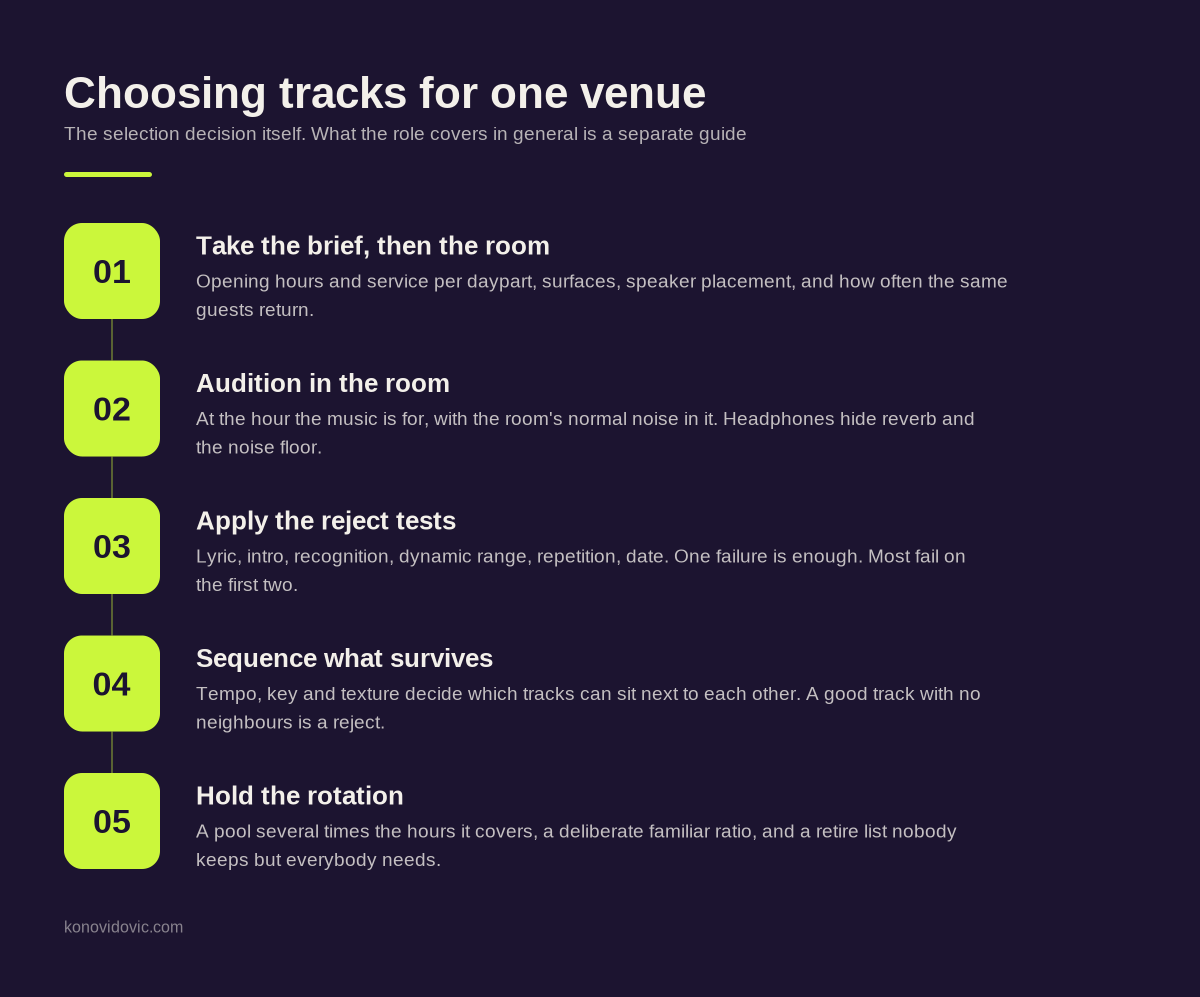
What the room does that headphones cannot show you:
- Reverb from hard surfaces. Tile, glass and concrete smear detail. A track built on a crisp rhythmic figure can turn to mush in a room with no soft furnishing anywhere.
- The noise floor. Extraction fans, a coffee grinder, a dishwasher, forty people talking. Everything below that floor is simply gone, which is why a track with its character in the quiet parts has no character here.
- Speaker placement and height. Ceiling speakers aimed down at a table do something different to a track than wall-mounted boxes firing across a space.
- Where people actually sit. A bar has a loud end and a quiet end, and almost nobody checks whether the programme works at both.
How Sequence Changes What Gets Selected
A track is never heard alone. It is heard after the one before it and before the one after it, and that changes which tracks I can accept at all.
Three things decide whether two tracks can sit next to each other: tempo, key and texture. Tempo is the one people know about and the easiest to handle. Key matters more than most briefs admit, because two tracks a semitone apart will sound like an error to anyone in the room even if they cannot say why. Texture is the one that causes real problems: a dense, heavily produced track followed by something sparse and dry reads as a drop in quality rather than a change of mood.
The practical consequence is that selection and sequencing are the same job, not two jobs in order. I have accepted tracks that were mediocre in isolation because they were the only bridge between two sections of an evening, and I have thrown out tracks I liked a great deal because nothing on either side of them worked.
Holding a Rotation Together
A selection that is right in week one and wrong in week ten was not a selection, it was a playlist. Three rules hold a rotation.
The pool is several times longer than the hours it covers. A room that plays six hours a day needs far more than six hours of material, or guests who visit twice a week start hearing patterns. Regulars notice repetition long before management does.
The familiar-to-unfamiliar ratio is deliberate. Too much unfamiliar material and the room feels like a test. Too much familiar material and it feels like a supermarket. The right balance depends on the venue and on how often the same people come back, which is why a neighbourhood cafe and an airport hotel need opposite answers.
Tracks get retired, not just added. The retire list is as important as the add list and almost nobody keeps one. A track comes off when staff have started skipping it, when it has dated, or when the room has changed around it.
That last line is not a formality. The music source and the licence are separate things, and commissioning a selection from me never supplies one. A venue playing music in public needs its own public performance licence, and what that costs and who issues it varies by country. If you want the overall framework rather than the selection method, music strategy consulting is where that sits.
Key Takeaways:
- Curators do not select good music, they select music that does one job in one room at one hour, which is a much narrower target and produces a long reject pile.
- Three questions come first: does it fit the hour, does it belong to the same family as everything else, and will it survive several hundred plays.
- Six tests throw tracks out: lyric, intro, recognition, dynamic range, repetition and date. Most candidates fail on the first two.
- Auditioning happens in the room, at the hour the music is for, with the room’s normal noise present. Headphones hide reverb, the noise floor and speaker placement.
- Selection and sequencing are one job. A track is judged beside its neighbours on tempo, key and texture, so a good track with no neighbours is still a reject.
- A rotation needs a pool several times longer than the hours it covers, a deliberate familiar-to-unfamiliar ratio, and a retire list.
Frequently Asked Questions
How do professional music curators choose tracks for venues?
By auditioning candidates in the actual room, at the hour the music is for, and rejecting anything that fails on lyrics, intro shape, over-familiarity, dynamic range, tolerance for repetition or datedness. Before that, every track has to fit the job of that hour, sit in the same family as the rest of the programme, and be capable of surviving several hundred plays without irritating the staff. Selection and sequencing happen together, because a track is only ever heard next to its neighbours.
Do curators listen to every track they put in a venue’s programme?
Yes, in full, and more than once. Listening to thirty seconds tells you nothing about the intro, the dynamic range or the one lyric that will carry across a dining room. The slow part of the job is not finding candidates, it is sitting through them.
How many tracks does a venue actually need?
Enough that a regular visiting twice a week does not start hearing a pattern, which means a pool several times longer than the hours it has to cover rather than a neat match. The exact number depends on how often the same people come back. A neighbourhood cafe needs far more material per hour of opening than a venue whose guests visit once.
Can I do this myself using a streaming service’s tools?
You can, and the part you will find hardest is the rejecting. Streaming tools are built to recommend more of what you liked, which is the opposite of the judgment a room needs, and they cannot hear your reverb, your noise floor or your extraction fan. If you want to try it, audition in the room at the right hour and keep a written reject list, because the reject list is where the programme actually takes shape.
Does a curated selection or a custom mix cover my music licensing?
No. A selection or a mix is a music source, nothing more. A venue playing music in public needs its own public performance licence, the requirement and the societies involved vary by country, and no amount of commissioned material changes that. Budget for the licence separately and arrange it directly.
How long does it take to select music for one room?
Longer than clients expect, because the listening does not compress. The brief and the walk-through are quick. Auditioning, rejecting and then sequencing what survives is the bulk of it, and a room with several dayparts is effectively several selections that have to agree with each other.
What is the most common mistake venues make when choosing their own music?
Choosing tracks they personally like, on headphones, in one sitting. All three parts of that are wrong: the room is not the listener, headphones hide what the space will do, and a programme assembled in one mood cannot cover a day that has several.
Ready to elevate your music strategy? Contact Kono with your opening hours and the rooms you need covered, or read what a custom DJ mix from EUR 249 includes.


