 Kono Vidovic
A dental practice needs two separate things that almost every supplier sells as one. It needs a room system whose job is masking and privacy, and it needs a per-patient option for the anxious person in the chair. They are different interventions, they go in different places, and only the second one has research behind it.
I have spent 34 years choosing music for commercial spaces, and clinics are the category where the usual advice transfers worst. A restaurant wants dwell time and a shop wants spend. A practice wants a reception desk where nobody overhears a diagnosis, a waiting room that does not amplify dread, and a treatment room where a clinician can concentrate. If you are still deciding how to supply the music at all, the routes and what each one covers are in commercial background music, explained.
What Is the Music Actually For in a Clinic?
Three jobs, and none of them is the one hospitality music does.
Masking treatment sounds. A waiting room is usually within earshot of a handpiece, a suction line and a raised voice. Those sounds do most of the work of making patients anxious before anyone has touched them, and a patient who has been listening to a drill for fifteen minutes arrives in the chair worse than they left home. Masking is an acoustic job: raise the noise floor enough that intermittent clinical sounds stop standing out.
Protecting speech privacy at reception. This is the one practices take least seriously and the one with actual consequences. If a patient at the desk is discussing a treatment plan, a payment problem or a medical history, everyone in the waiting room can usually hear it. Continuous sound at reception makes conversation at the desk unintelligible a few metres away, which is a confidentiality control, not a nicety.
Not sounding like a clinic. A genuinely silent waiting room makes people listen harder to exactly what you do not want them listening to. That is the opposite of the argument I make for luxury hotel arrival spaces, where I argue for silence, and the reason is that the sounds in the next room are different.
What the Research Supports, and What It Does Not
Here is where the category misleads people, including suppliers who should know better.
There is real evidence that music reduces dental anxiety. In a randomised controlled trial published in the Journal of Clinical Medicine in February 2026, İşcan Yapar and colleagues assigned 75 patients with measurable dental anxiety to three groups of 25: classical music, Turkish music, and no music, during restorative treatment. Both music groups showed significant reductions against the control group in self-reported anxiety on the Modified Dental Anxiety Scale and in physiological stress markers including blood pressure, heart rate and salivary cortisol. The authors note as a limitation that only two types of music were tested.
The music in that trial was delivered through headphones worn by the patient, during the procedure, from the local anaesthetic to the end of treatment. The paper does not describe room speakers, background music or a waiting room at all.
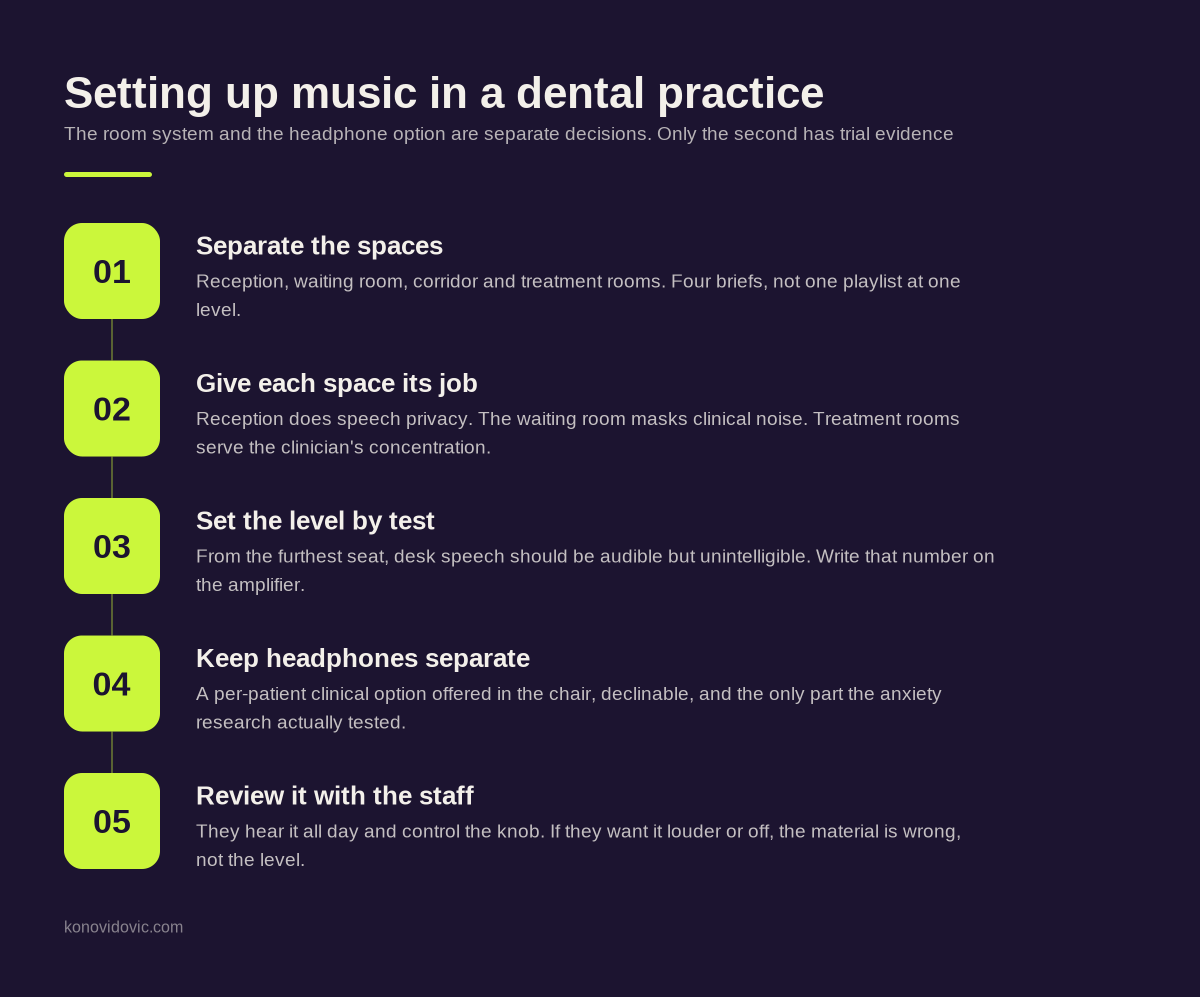
So what that evidence supports is offering headphones to an anxious patient in the chair. It says nothing about what should come out of your ceiling speakers, and a page that cites anxiety research to sell you a background music subscription has quietly swapped one intervention for another. I have no research to offer you on the room system. The masking and privacy arguments above are acoustics and my own practice, and you should read them as that rather than as findings.
Headphones in the chair
- Supported by trial evidence on anxiety and stress markers
- Chosen per patient, by the patient, and declinable
- Patient's own device and playlist works and costs nothing
- Does not interfere with the clinician's own concentration
- A clinical option offered at the appointment, not a system
The room system doing that job instead
- No trial evidence that it reduces a patient's anxiety
- One selection imposed on everyone in the building
- Nobody can opt out, including staff on an eight-hour shift
- Loud enough to reassure one patient is loud enough to annoy a clinician
- Sold as a wellbeing intervention on borrowed evidence
Reception, the Waiting Room and the Treatment Room
Three spaces, three different briefs, and the common failure is one playlist at one volume across all of them.
| Space | What the sound is for | Direction |
|---|---|---|
| Reception desk | Speech privacy. Making conversation at the desk unintelligible from the seats | Continuous, no strong melodic hooks, level set by the privacy test below |
| Waiting room | Masking clinical sound and not amplifying dread | Steady, low dynamic range, nothing with a pulse that reads as urgency |
| Treatment room | The clinician’s concentration, and whatever the patient has chosen | Quietest of the three, or nothing, with headphones available to the patient |
| Corridors to treatment | Continuity so the walk does not get quieter and more ominous | Same family as the waiting room, a little lower |
The treatment room is the one to be careful with. The person who has to live with that sound for eight hours is the clinician, and a dentist concentrating on a margin does not need a vocal hook. In most practices I would run the treatment rooms at a level barely above the equipment, or leave them silent and offer the patient headphones.
The Volume, and the Privacy Test
Set reception by test rather than by feel. Stand where the furthest waiting patient sits while a colleague holds a normal conversation at the desk, at normal volume, about something harmless. Raise the level until you can tell someone is speaking but cannot make out the words. That is the number. Write it on the amplifier and train the desk staff to leave it there.
Two things that break it, both common:
- Staff turning it down to hear the phone. Fix the phone, not the level. A handset with a volume control or a headset costs less than a privacy complaint.
- Staff turning it up at the end of a long day. Which is the honest signal that the material is wrong rather than the level. If the people who hear it most want it louder or off, the selection has failed, and the BPM and energy question is the same one I work through for restaurant and retail rooms, just at the bottom of the range.
What Not to Play
The reject tests I apply in any venue get sharper in a clinic, where a lyric lands differently.
Radio deserves its own line. A practice that runs a commercial station has outsourced its waiting room to whatever comes next, which on any given morning includes a news item about a health scare and an advertisement for a competitor.
Does a Practice Need a Music Licence?
Yes, in almost every case, and the fact that you are a healthcare provider rather than a hospitality venue does not change it. Playing recorded music where patients and staff can hear it is a public performance, it is arranged nationally, and the obligation sits with the practice rather than with whoever supplied the music.
| Country | Societies | Licence route |
|---|---|---|
| Netherlands | Buma/Stemra and Sena | mijnlicentie.nl |
| UK | PPL and PRS for Music | TheMusicLicence via PPL PRS |
| Germany | GEMA and GVL | Separate, both required |
Commissioning a mix never supplies that licence. A custom DJ mix from EUR 249 is a music source built for your rooms, and the public performance licence remains a separate purchase that you arrange with your own national society. Ask any supplier in writing which licence they provide and which stays yours, and keep the answer.
One narrow exception worth knowing: music a patient plays to themselves through their own headphones is not a public performance, which is a further practical argument for the headphone route in the chair.
Key Takeaways:
- A practice needs two different things: a room system for masking and speech privacy, and headphones as a per-patient option in the chair. Suppliers sell them as one product.
- The dental anxiety evidence, including the 2026 randomised trial in the Journal of Clinical Medicine, tested music delivered through headphones during treatment. It does not support claims about what your ceiling speakers play.
- The masking and privacy case is acoustics and my own practice rather than a research finding, and should be read that way.
- Set the reception level by the privacy test: audible speech, unintelligible words, from the furthest seat. Write the number down.
- Reception, waiting room and treatment room want different things. The treatment room should be the quietest, or silent, with headphones offered.
- The practice needs its own public performance licence wherever patients can hear the music, and no music source supplies it.
Frequently Asked Questions
What music should a dental office play?
Steady material with a narrow dynamic range and no strong lyrical content, at a level set by a privacy test rather than by taste. The waiting room and reception need continuous sound to mask treatment noise and make desk conversation unintelligible from the seats. Treatment rooms should be quieter still, or silent, because the person living with that sound all day is the clinician. Avoid radio, chart material and anything whose lyrics mention pain or teeth.
Does music actually reduce dental anxiety?
The evidence says yes for music delivered to the patient through headphones during treatment. A 2026 randomised controlled trial in the Journal of Clinical Medicine assigned 75 anxious patients to classical music, Turkish music or no music via headphones, and both music groups showed significant improvements against control in self-reported anxiety and in physiological stress markers. What that does not establish is any effect from background music through room speakers, which is a different intervention and routinely confused with it in supplier marketing.
Should we give patients headphones or play music in the room?
Both, for different reasons. Headphones are the option with evidence behind it, they are chosen per patient and can be declined, and a patient’s own phone and playlist works at no cost to you. The room system is not there to calm an individual patient; it is there to mask clinical noise and protect conversations at the desk. If you can only do one, headphones in the chair is the one with research support.
How loud should waiting room music be?
Loud enough that a conversation at the reception desk is audible as speech but unintelligible from the furthest seat, and no louder. Set it by standing in that seat while a colleague talks at the desk, then write the number on the amplifier. If staff keep raising it, the material is wrong rather than the level.
Can we just use Spotify in our waiting room?
No. A consumer subscription is licensed for personal, non-commercial listening, so a waiting room falls outside its terms, and it will eventually play an advertisement to a room full of patients. Use a commercial service or commissioned material, and arrange the public performance licence separately.
Do dental practices need a music licence?
In almost every country, yes. Music that patients or staff can hear is a public performance, the licence is arranged nationally through your own collecting societies, and being a healthcare provider does not exempt you. Music a patient plays to themselves through their own headphones is the narrow exception, because that is not a public performance.
Is silence better than music in a waiting room?
Usually not, and this is where clinics differ from the luxury hospitality spaces where I argue for silence. A silent waiting room makes people listen harder, and what they hear is the handpiece in the next room. Masking is the reason to have sound here at all.
Ready to elevate your music strategy? Contact Kono with your floor plan and the spaces you need covered, or read what a custom DJ mix from EUR 249 includes.


