 Kono Vidovic
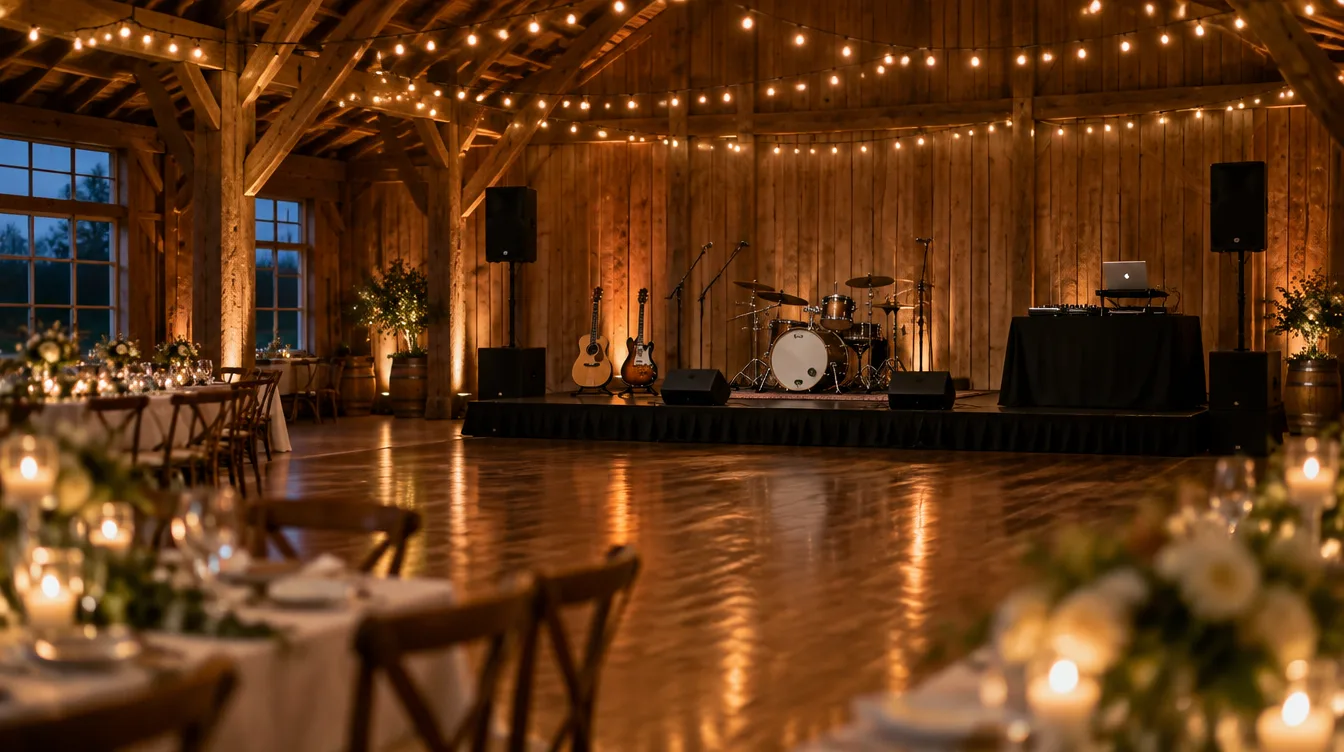
A wedding needs music for roughly ten hours and a live band plays about two of them. That is the fact the comparison usually skips, and once you take it seriously the question stops being DJ or band and becomes what covers the other eight hours.
I play weddings and I do not supply bands, so take the partiality as read. What follows is not the general DJ-against-band argument, which I have already resolved for corporate events and which turns on the same mechanics either way: continuity, footprint, volume and repertoire breadth. A wedding changes which of those matter, and adds two that a company event never has.
The Four Things That Actually Decide It
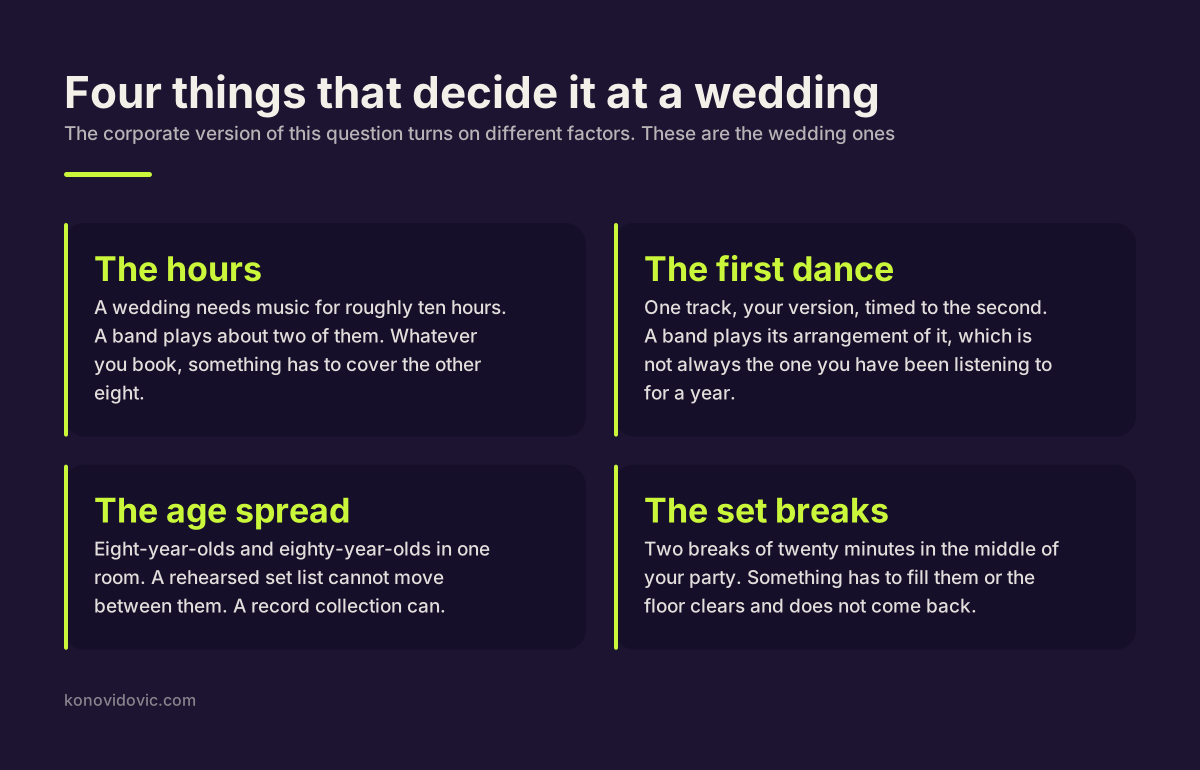
Not cost, and not whether live music is nicer. Those are real but they are not what the decision turns on.
- The hours. Ceremony, drinks, dinner, speeches, first dance, party, last song. A band covers the party and nothing else.
- The first dance. One track, your arrangement, timed to the second.
- The age spread. A wedding puts eight-year-olds and eighty-year-olds in one room, which no rehearsed set list spans.
- The set breaks. Two gaps of around twenty minutes, in the middle of the part you care most about.
The Hours Problem
A band is a performance, not a music supply. It plays its set and stops, and your guests arrived six hours earlier.
This is where most couples get caught, because the band quote arrives in the same shape as the DJ quote and looks comparable. It is not. A DJ covering the whole day and a band playing two sets are different purchases, and comparing their prices directly compares a full day against an evening slot.
Which parts of the day need which treatment is a question I have worked through separately in which parts of your wedding actually need a mix, and the short version is that everything before the dancing wants reliability rather than performance.
The First Dance
This is the one I would push back on hardest, and it is wedding-only.
You have chosen a track. You have probably listened to that specific recording a hundred times, possibly practised to it, and the version in your head is the version on the record: that arrangement, that tempo, that length. A band plays its own arrangement. Good bands learn it carefully and some get very close. They are still playing a cover of the song you fell in love with, at a slightly different tempo, with a different voice.
Some couples do not mind at all and a live first dance is genuinely moving. Others realise during the three minutes that it is not quite the song. Decide which you are before you book, not in the week of the wedding.
The practical compromise most couples land on: the recorded track for the first dance, the band from the second song onward.
The Age Spread
A wedding is the only event where the same room contains your grandmother, your university friends and several children, and all of them are expected to dance at some point.
A band has a set list, rehearsed, usually settled weeks ahead. It is good at one thing and will do that thing well for two hours. If that thing matches the room, it is excellent. If the room turns out to want something else at half past eleven, the set list is what it is.
A DJ’s entire job is moving between those audiences within a few tracks. That is the actual argument for a DJ at a wedding, and it is stronger here than at any other kind of event precisely because the age range is wider.
| Band | DJ | |
|---|---|---|
| Spans a 60-year age range | Within one genre | Across decades, within minutes |
| Reacts to an emptying floor | Skip or extend within the set | Change direction on the next track |
| Plays your specific must-plays | What they know, learned in advance | Any recording that exists |
| Handles the do-not-play list | Easily, it is their set anyway | Easily, agreed in the brief |
The Set Breaks
Two breaks of around twenty minutes, usually, in the middle of your party.
At a corporate event this empties the room. At a wedding it is worse in a different way: your guests have been there nine hours and the floor is finally full, and then it stops. A playlist through the PA is the common fallback and it is audibly a fallback.
If you book a band, settle this in writing before you sign: what plays during the breaks, who operates it, and whether the band supplies that themselves. Plenty do, and the ones that do not will not mention it.
So, Both?
At a corporate event booking both is an upgrade. At a wedding it is closer to the normal configuration, because a band was never going to cover the day anyway.
The arrangement that works
- Prepared music for the ceremony, drinks and dinner
- The recorded track for the first dance, if that matters to you
- Band for one defined set as the centrepiece
- DJ from the end of that set to the last song
- Handover times written into both contracts
What goes wrong
- Band booked, rest of the day left to a phone
- First dance discovered to be a different arrangement
- Nobody owning the twenty-minute breaks
- Two suppliers who have never spoken to each other
- Comparing a two-hour quote against a ten-hour one
If the budget only stretches to one, a DJ covers the whole day and a band does not. That is not a close call, and I would say it even if I supplied both.
What It Costs to Compare Honestly
Compare like for like or the numbers mislead you. I have set out what moves a quote in wedding DJ cost, and the same discipline applies here: fix the span first, then ask both suppliers to quote it.
| Deliverable | Price | Unit |
|---|---|---|
| Custom mix, 60 minutes | EUR 249 | Per mix, one-off, excludes VAT where applicable |
| Custom mix, 90 minutes | EUR 349 | Per mix, one-off, excludes VAT where applicable |
| Custom mix, 120 minutes | EUR 449 | Per mix, one-off, excludes VAT where applicable |
| Live wedding booking | Request a quote | Per event, excludes travel and accommodation |
Prepared mixes are the cheap way to solve the hours problem. A ceremony and a dinner service need the right music at the right length with no surprises, which is exactly what a sequenced mix delivers and exactly where live performance adds nothing.
Who Arranges the Licence?
At a licensed venue, the venue, and the format makes no difference. A premises licence covers recorded music and live performance of other people’s songs alike.
Where it changes is a marquee, a private house or any dry-hire space, which is far more common at weddings than at corporate events. There the obligation usually falls to whoever is organising, which means you. It varies by country: Buma/Stemra and Sena in the Netherlands through mijnlicentie.nl, TheMusicLicence from PPL PRS in the UK, GEMA and GVL in Germany, and separate ASCAP, BMI, SESAC and GMR licences in the United States.
Booking a DJ never supplies one, booking a band never supplies one, and buying a mix never supplies one. Ask your venue in writing which licence it holds, and if the answer is none, ask who they expect to arrange it.
Key Takeaways:
- A wedding needs about ten hours of music and a band plays about two, so the real question is what covers the rest.
- The first dance is a format decision: a band plays its arrangement, not the recording you have been listening to all year.
- The age spread at a wedding is wider than at any other event, which is the strongest argument for a DJ.
- Settle the set breaks in writing before signing with a band: what plays, and who operates it.
- At a licensed venue the licence is the venue’s whichever you book. At a marquee or private house it is usually yours.
Frequently Asked Questions
Should we book a wedding DJ or a live band?
If the budget only covers one, a DJ, because a band covers roughly two hours of a ten-hour day and a DJ covers all of it. If the budget covers both, the arrangement that works is prepared music for the ceremony and dinner, a band for one defined set, and a DJ from the end of that set to the last song.
Can a live band play our first dance?
Yes, and a good one will learn it carefully, but it will be their arrangement rather than the recording you have been listening to. Some couples find a live first dance more moving; others notice during the three minutes that it is not quite the song. Decide which you are before booking. Many couples use the recorded track for the first dance and bring the band in from the second song.
Is a band more expensive than a wedding DJ?
Usually, but the figures are not comparable as quoted, because a band prices a two-hour set and a DJ prices the day. Fix the span you want covered first, then ask both to quote against it. Otherwise you are comparing an evening slot with a full day and concluding the wrong thing.
What happens during a band’s set breaks?
Typically two gaps of around twenty minutes, and at a wedding that is when the floor finally fills and then empties. Some bands supply recorded music and an operator for the breaks; many do not and will not raise it. Agree in writing what plays and who runs it before you sign.
Can a band handle a wide range of guest ages?
Within its genre, yes. Across a sixty-year age range, not really, because a set list is rehearsed and fixed. That is the clearest argument for a DJ at a wedding specifically: the room contains more different audiences than at any other kind of event, and moving between them is what a DJ does.
Do we need a music licence for our wedding?
At a licensed venue, no, because the venue holds it, and this is true whether you book a DJ or a band. At a marquee, private house or dry-hire space the obligation usually falls to you as the organiser. It varies by country, so ask your venue in writing which licence it holds.
Want this decided against your actual venue and running order rather than in the abstract? Send me your date, venue and timings and I will tell you honestly what your day needs, or read 25 questions to ask your wedding DJ before you speak to anyone.