 Kono Vidovic
A DJ for a private party needs four things from you: a socket that will hold the load, about two metres of floor to stand in, a firm finish time, and an honest description of the room. Not a genre list. Every private booking that has gone wrong in 34 years went wrong on one of those four, and never on the music.
A private party is also the one booking where the host is the client, the venue manager and the guest at the same time, which is why it runs differently from a company event or a wedding. If you already know the date, booking enquiries start with the address, the finish time and roughly how many people. What follows is everything I ask before I accept one.
What Does a Private Party DJ Need From You?
Power, floor space, a finish time and a description of the room. That is the whole list, and the description matters more than people expect.
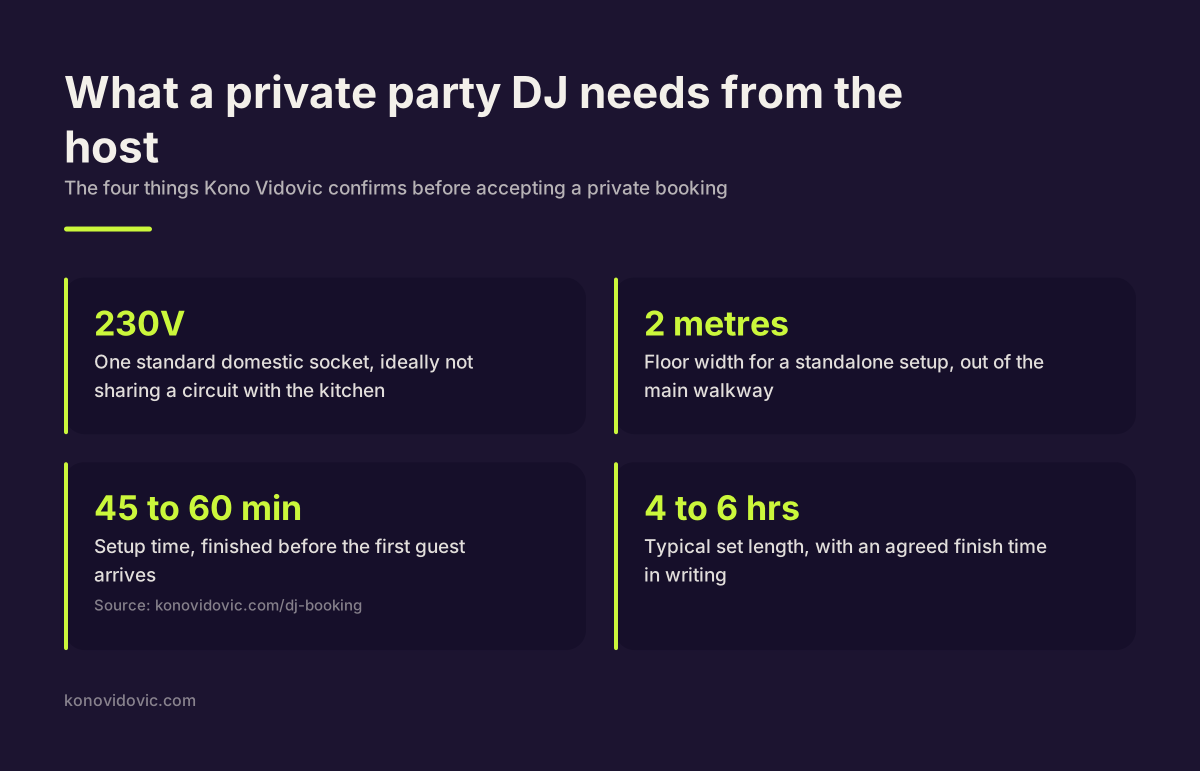
I bring my own controller, laptop, audio interface and, for smaller rooms, my own speakers, so equipment is rarely the question. What I cannot bring is a circuit that is not already carrying an oven and a dishwasher, or a corner that nobody is walking through. The booking page lists the technical side; this page is about the parts of a home or a hired room that nobody thinks to mention.
- The room, described honestly. Low ceilings, bare floors, a conservatory, an open-plan kitchen. Each of those changes how loud the room needs to be before it sounds right, and bare hard surfaces make a room sound louder than it measures.
- Who is actually coming. Not ages in a range. “Twelve of us from university, my parents, and four children who will be asleep by ten” is a brief. “Mixed ages” is not.
- What the party is for. A fortieth, a leaving party and a housewarming want different arcs even with the same guests in the same room.
- The one song that matters. Most hosts have one. Tell me early and I will have the right version rather than whatever is on the service.
Does a House Party Need a Music Licence?
In the Netherlands, usually not, and this is the one page on this site where the answer to a licensing question is no. BumaStemra’s own guidance states the general rule is that you need permission to play music at a party, then sets out the exception: it does not apply where “your guests are family, friends or similar, and no entrance fee is charged for the party”, with the condition that “all guests have a mutual or family relationship with each other”. A birthday party with invited friends sits inside that.
Three things take you straight back outside it.
- An entrance fee, or any charge at the door. Once money changes hands for admission, the exception goes.
- A company party. BumaStemra is explicit that this “does not include a company party. A licence is required for this.” If your employer is paying and colleagues are invited, it is not a private party in the licensing sense, whatever it feels like.
- An open invitation. A guest list that anyone can join is not a group with a mutual relationship.
In the UK the test is framed the other way round. PPL PRS, which issues TheMusicLicence, describes performing in public as, “broadly speaking, this includes any presentation of music outside of a domestic setting”. Your own home is a domestic setting. A hired hall is not, although a hired venue normally holds its own licence, so ask the venue in writing rather than assuming either way.
| Country | Who to ask | Private domestic party |
|---|---|---|
| Netherlands | BumaStemra and Sena via mijnlicentie.nl | Exempt where guests are family or friends and no entrance fee is charged. A company party is not exempt |
| UK | PPL PRS | Music “outside of a domestic setting” is a public performance. A hired venue usually holds its own licence |
| Germany | GEMA and GVL | Both required where a licence applies. Confirm with GEMA |
| United States | ASCAP, BMI, SESAC and GMR | Separate licences, no joint venture. Confirm per society |
Two things this does not change. If your party falls outside the exception, booking a DJ does not supply the licence and neither does buying a prepared mix: a custom DJ mix from EUR 249 is where the music comes from, not permission to play it in public. And if you are hiring a room rather than using your own home, the obligation usually sits with whoever is organising unless the venue’s own licence covers it. Ask, in writing, before the day.
Will Your Power Supply Hold?
One standard 230V socket is enough for a standalone setup, but it should not be sharing a circuit with the kitchen. This is the most common practical failure at a house party and it is entirely preventable.
An oven coming on mid-evening in an older house is a genuine way to lose the music. A DJ cannot plan around a circuit nobody has looked at, and finding out at nine in the evening is the worst version of this.
Where Will the DJ Actually Stand?
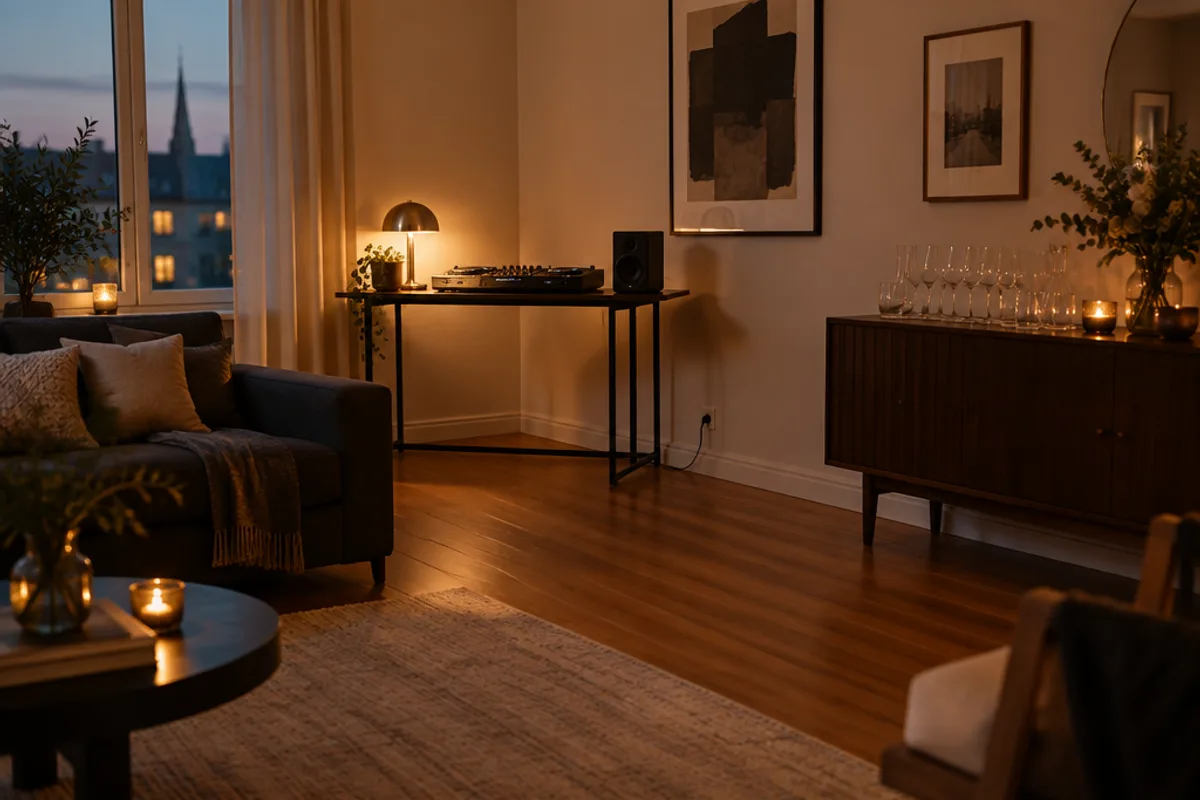
Pick the spot before the day, and pick it for sound rather than for sightlines. About two metres of width, somewhere nobody needs to walk through, and ideally not in a corner with hard surfaces on both sides.
Three mistakes I see repeatedly in homes:
- The thoroughfare. The natural-looking space is often the route between the kitchen and the garden. It is the one place the setup cannot go.
- The far corner from everybody. Sound needs to reach the room, not the wall. A corner at the end of an L-shaped space leaves half the party in a different acoustic.
- Directly next to a sleeping child’s room. Decide this with the floor plan in mind, not on the night.
Access matters too. Stairs, a lift with a weight limit, a narrow hallway or a long walk from where a van can stop all change setup time, and setup needs to finish before guests arrive, not around them.
What About the Neighbours?
Tell them, in person, before the day, and agree the finish time with yourself before you agree it with anyone else. At a venue, noise is the venue’s problem. At home it is entirely yours, and local rules on residential noise vary by municipality, so check your own council’s position rather than relying on a general rule.
| Decision | At a venue | At a private home |
|---|---|---|
| Who owns the noise limit | The venue, often with a limiter | You, under local residential rules |
| Who tells the neighbours | Nobody needs to | You, in advance and in person |
| What sets the finish time | The venue’s licence | Your agreement with the street |
| Who adjusts the volume | Venue management | You, and it should be you rather than the DJ |
A DJ can hold a level all night once you have given a number, and the level is a decision rather than a negotiation at midnight. What does not work is leaving it unspoken and then asking for it to come down twice an hour.
How Many Hours Should You Book?
Four to six hours covers most private parties, and the useful question is not how long but when the music should change character. I would rather play five hours with a shape than seven hours flat.
A party with no running order still has an arc: people arriving and talking, the point where the room commits, and the hour that takes everyone toward leaving. Tell me when food happens, if it does, and whether there is a speech. Both reset the room, and both are easier to play around than through.
How Do You Handle Requests From Friends?
Agree the rule with me in advance and then let me be the one who says no. At a private party the requests come from people who know you, which makes refusing them your problem unless you hand it over.
What works, in my experience:
- A do-not-play list. Five or six tracks or artists, written down before the day. Short lists get respected; long ones get negotiated.
- One named person besides you who can approve a change, so you are not being asked while you are hosting.
- Agreeing that I take the requests directly rather than them coming through you. It is a normal part of the job and it keeps you out of it.
If you want a particular stretch of the night fixed rather than read live, a prepared mix handles that part and leaves the live playing for when the room is unpredictable. That is also how the ceremony-and-dinner parts of a wedding are usually solved, which I have set out separately in wedding DJ cost.
Key Takeaways:
- A private party DJ needs four things: power on a circuit that is not shared with the kitchen, about two metres of floor, a finish time in writing, and an honest description of the room and the guests.
- In the Netherlands a genuine private party is exempt from BumaStemra licensing where guests are family or friends and there is no entrance fee, but a company party is explicitly not exempt and a charge at the door removes the exemption.
- In the UK the test is whether the music is presented outside a domestic setting, so your own home differs from a hired hall, and a hired venue usually holds its own licence.
- Power is the most common practical failure at a house party, and it is entirely preventable with one check a week before.
- At home the noise limit and the neighbours are yours, not the DJ’s. Decide the finish time and the volume in the afternoon, not at midnight.
Frequently Asked Questions
How much does a DJ for a private party cost?
It depends on the hours, the travel and whether a sound system is needed, so I quote per event rather than publish a rate that would be wrong for most bookings. Send the date, the address, the finish time and a rough guest count. What moves a private quote most is travel and set length, in that order.
Do I need a music licence for a party at my house?
In the Netherlands, usually not. BumaStemra’s guidance exempts gatherings where your guests are family, friends or similar, where all guests have a mutual or family relationship, and where no entrance fee is charged. A company party is explicitly excluded and does need a licence. In the UK the question is whether the music is presented outside a domestic setting. Check your own country’s society, and if you are hiring a room rather than using your home, ask the venue in writing which licence it holds.
What power does a DJ need at a house party?
One standard 230V socket close to the setup, preferably not on the same circuit as the oven, dishwasher or electric heaters. Daisy-chained extension leads and cable reels left coiled on the drum are the two things to avoid. For an outdoor party, confirm a weather-protected feed with an RCD, and make sure someone who is not drinking knows where the fuse box is.
How many hours should I book a DJ for?
Four to six hours suits most private parties. The more useful decision is where the evening changes character: when people stop arriving, when the room commits, and the final hour that moves everyone toward the door. Tell me when food or a speech happens, because both reset the room.
Can I give the DJ a playlist for my party?
A do-not-play list, yes, and keep it to five or six tracks or artists so it gets respected rather than negotiated. A full playlist is a different purchase: if you want a specific stretch of the night fixed in advance, that is a prepared mix rather than a live booking, and the two can be combined in one evening.
Who deals with the neighbours and the noise?
You do, which is the real difference between a home party and a venue. A venue owns its noise limit and often has a limiter wired in; at home the limit comes from local residential rules, which vary by municipality. Tell the neighbours in person beforehand, decide a finish time and a volume in advance, and give the DJ the number rather than renegotiating it through the evening.
Want a straight answer on hours and cost for your date? Send me the address, the finish time and a guest count and you will get a quote with the hours itemised, or get in touch if you are still deciding what kind of night it is.